How Should I Compare ABS Module Repair with a Refurbished Replacement
ABS Module Lab Team · · updated · 17 min read
Compare ABS module repair with refurbished replacement using cost, turnaround time, and module condition to decide which option fits your situation.
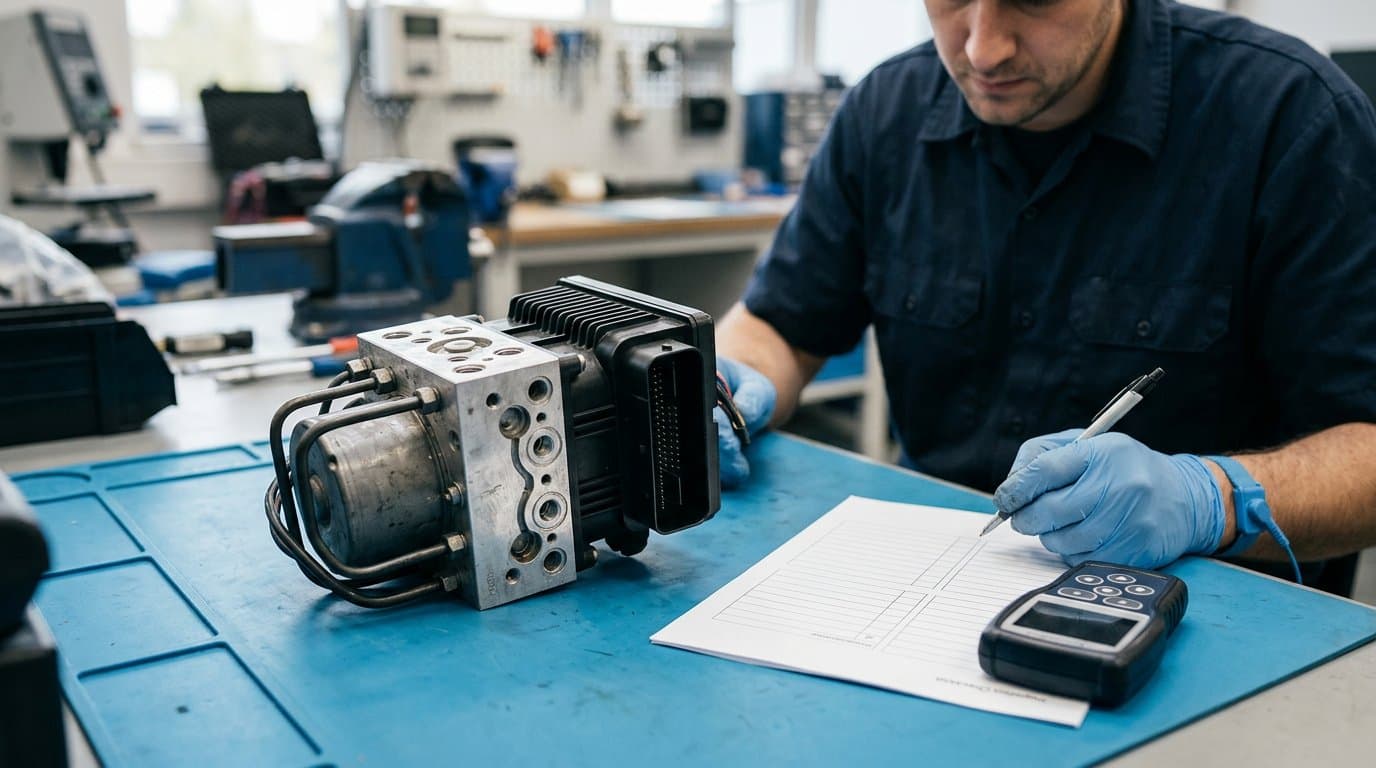
When your ABS warning light stays on and a scan confirms the module itself has failed, you face a straightforward decision: repair the controller you already own, or replace it with a refurbished unit that carries your vehicle's data. The answer depends on three factors—cost difference, turnaround time, and whether your original module can be repaired—but both options from ABS Module Lab return a fully coded unit ready to install, with the same warranty and no dealer programming visit.
This article explains what bench repair and refurbished replacement each deliver, compares the cost structure for both, identifies when one option is clearly better than the other, and clarifies the part-number and programming requirements that apply to either choice. Every section uses verified service details from ABS Module Lab's documented capabilities for mail-in ABS module work.
The Three Criteria That Define Your Decision
Three factors determine whether repair or refurbished replacement makes sense for your situation: the price difference, your timeline, and the condition of your original module when it reaches the bench.
Price difference: Bench repair of a conventional ABS module starts from $499 plus return shipping, while a refurbished replacement with your data cloned onto it starts from $950 plus return shipping. The gap narrows if the bench discovers extensive damage that pushes the repair cost higher, but the final repair price must be approved before any additional work begins.
Timeline: Both services take about one week on the bench. Rush service (two to three business days) is available for an additional $100 on either option. The critical difference is that refurbished replacement requires your original module to arrive first, because your vehicle's VIN, coding, and configuration data is read from your unit and written into the refurbished controller—no advance exchange is offered.
Module condition: If the bench finds your module unrepairable, ABS Module Lab stops work and presents two options: a refurbished replacement with your data cloned for the difference in price (you pay only the gap from what you already paid), or your repair price refunded minus shipping costs and a $150 bench evaluation fee. Nothing that changes your cost happens without your approval.
What Bench Repair Actually Delivers—and What It Does Not
Bench repair means your own ABS module is tested, the failed components are replaced, the unit is retested to verify it meets functional specifications, and then it ships back to you. Because it is your original module, it retains the VIN, coding, and configuration data already stored in its memory—no dealer programming visit is required after installation.
What comes back: Your module with new or refurbished internal components (circuit board repairs, replaced relays, remanufactured pump motors or valve solenoids as needed), tested on bench equipment that simulates the signals and loads the module would see in the vehicle. It installs exactly as your original did before it failed. Some vehicles still require a brake bleed, initialization, or calibration procedure after the module is installed, depending on the vehicle manufacturer's service procedures.
What does not change: The module's external housing, connector pins, mounting brackets, and internal software version remain original to your unit. If your module's housing is cracked, corroded beyond cleaning, or the connector is damaged, bench repair may not be possible—that determination happens during inspection.
Warranty and coverage: Every repair includes a one-year warranty on the work, counted from the day the module ships back. If additional work beyond the starting service price is needed, the bench quotes the revised cost and waits for your approval before proceeding. For example, Nissan ABS actuator repair starts from $499, but if the pump motor and valve-body circuit board both require replacement, the final price will be higher—and quoted before the work is done.
Bench repair does not include diagnosing the vehicle's other systems, replacing brake lines or wheel-speed sensors, or addressing mechanical issues that caused the module to fail. The module itself is repaired; the vehicle's hydraulic and sensor circuits are your responsibility or your shop's.
What a Refurbished Replacement Module Includes
A refurbished replacement is a different ABS module from the same controller family, rebuilt to functional specification, that receives your original module's VIN, coding, and configuration data through a cloning process. It installs like your own module because it carries your vehicle's data, eliminating the dealer programming step that a new or generic used module would require.
What you receive: A tested ABS module of the same manufacturer and controller family as your original, with your vehicle's identification and configuration written into its memory. The refurbished unit undergoes the same bench testing as a repaired module and ships with the same one-year warranty.
What happens to your original: Your module becomes the core and stays with ABS Module Lab—there is no separate core charge, and you do not pay a deposit. The cloning process requires your original to arrive at the bench first, which is why no advance exchange is available. Once your data is transferred, the refurbished unit ships back.
When this option is automatic: If your original module reaches the bench and is found unrepairable (circuit board damage beyond economical repair, housing failure, or internal contamination from brake fluid intrusion), ABS Module Lab halts the repair process and offers the refurbished replacement as an alternative. You approve the difference in cost, and the replacement proceeds. For modules listed on the refurbished ABS modules inventory, this transition happens without sending your module back and starting over.
Refurbished replacement does not mean a new unit from a parts supplier—it is a remanufactured controller from the same OEM family. It also does not bypass the vehicle-specific coding requirement; the cloning process exists specifically to pre-code the module to your VIN before it ships.
Cost Comparison: Repair vs. Refurbished Replacement
The starting prices for both services establish a baseline, but the final cost depends on what the bench discovers during inspection. Understanding how pricing works for each option helps you evaluate quotes accurately and compare them to other repair sources or new-unit prices.
Repair cost structure: ABS module repair pricing begins at a controller-family starting point (for example, $499 for many Toyota and Nissan actuator assemblies) and increases if the inspection reveals additional failed components. ABS Module Lab discloses the higher cost and waits for approval before proceeding. Return shipping adds $29.95 and up, depending on location and carrier. Rush service (two to three business days on the bench instead of one week) adds $100.
Refurbished replacement cost structure: Replacement starts from $950 for most conventional ABS units, plus return shipping and optional rush service. If you initially ordered a repair and the bench determines your module cannot be repaired, you pay only the difference between what you already paid and the replacement price—the original repair payment credits toward the replacement.
New-unit comparison for context: New ABS modules purchased through parts suppliers typically range from $1,200 to over $3,000 depending on the vehicle, and arrive without vehicle-specific coding. Dealer programming (required for nearly all modern ABS controllers) adds $150 to $300 in labor. Some vehicles require additional initialization or calibration procedures that extend shop time further. A documented example from the hybrid brake actuator page shows new units listed at $1,703.29 to $1,782.74 for that specific family, with no coding included.
Cost decision point: If your repair quote comes back at $700 and a refurbished replacement is offered at $950, the $250 difference buys you a unit with more recently replaced internal components. If the repair quote is $500 and the replacement is $950, repair delivers a $450 saving. The decision hinges on your budget and how much of the hardware you want renewed. Both options carry the same one-year warranty.
When comparing any quote to ABS Module Lab's pricing, verify what is included: the competitor's quote should specify whether the module returns coded to your vehicle, whether the price includes return shipping, what the warranty term is, and what happens if the module is unrepairable. Many mail-in repair services charge a diagnostic fee even if they cannot complete the work.
When Repair Is the Better Option and When It Is Not
Certain situations clearly favor one option over the other. Repair makes sense when your module's physical condition is good, the failure is isolated to a specific circuit or component, and your budget prioritizes the lowest immediate cost. Refurbished replacement is preferable when the module shows corrosion, has a history of intermittent faults, or when you want the peace of mind that comes with a more extensively rebuilt unit.
Repair is the better choice when:
- Your module is relatively recent (less than ten years old) and the housing, connector, and circuit board show no corrosion or physical damage when you inspect it.
- The fault codes point to a specific pump motor, valve solenoid, or relay circuit—components that can be replaced individually during bench work.
- You have already confirmed the part number and the controller family is commonly repaired (for example, Bosch 5.7, ATE MK60, or Toyota brake actuators).
- Your budget does not accommodate the higher upfront cost of a refurbished unit, and the starting repair price fits your situation.
- The vehicle is older or high-mileage, and you plan to keep it only another year or two—repair delivers functional performance without the investment in a more extensively remanufactured unit.
Refurbished replacement is the better choice when:
- Your module has visible corrosion around the connector, brake fluid staining on the housing, or a history of intermittent faults that suggest internal contamination.
- You have already attempted a repair elsewhere and the module failed again within months—the original repair may have addressed only one of multiple degraded circuits.
- The vehicle is worth keeping long-term, and you want the durability that comes from replacing more internal wear components during the remanufacturing process.
- The repair quote comes back significantly higher than the starting price because multiple circuits need work—at that point, the cost difference between repair and replacement narrows.
When neither option works: If your module is subject to an open manufacturer recall, most independent repair facilities (including ABS Module Lab) will not service it until the recall is resolved. Take the vehicle to the dealer first to determine whether the recall repair is still available at no charge. Some hybrid brake actuators and certain Takata-recall-related ABS units fall into this category.
The ABS Module Repair Estimate Checklist: Part Numbers, Fault Codes, and Questions to Ask article provides the exact information a repair facility needs to give you an accurate quote, which helps you decide between repair and replacement before committing to either.
The Part Number, VIN Data and Programming Question
Both bench repair and refurbished replacement depend on precise part-number identification and proper handling of the vehicle's coded data. Understanding what each service requires—and what happens if the part number is wrong—prevents delays and ensures the module you receive installs correctly.
Part number identification: The part number stamped or printed on your ABS module's label is the single most critical piece of information for an accurate estimate. ABS controllers are grouped into families (for example, all Bosch 5.7 units share the same basic architecture, but individual part numbers reflect variations in valve count, sensor inputs, and vehicle-specific coding). A photo of the label, along with your VIN, allows ABS Module Lab to confirm the controller family and provide a firm price before you ship anything.
VIN and coding data: Modern ABS modules store vehicle identification, feature configuration (wheel speed sensor type, stability control presence, traction control settings), and in some cases odometer data. When your module is repaired, this data remains untouched because the circuit board and memory stay in your original housing. When a refurbished replacement is prepared, ABS Module Lab reads your original module's data and writes it into the replacement unit's memory—this is the cloning process that allows the refurbished module to install without dealer programming.
What does not require dealer programming: Both repaired and refurbished modules from ABS Module Lab return pre-coded to your vehicle, so the installation procedure is: remove the failed module, install the serviced or replacement module, reconnect the brake lines and wiring harness, and perform any manufacturer-required brake bleeding or system initialization. Some vehicles need a scan tool with bidirectional control to cycle the ABS pump or open and close solenoid valves during the bleed procedure, but that is a bleed process, not a programming session.
What still requires a dealer or scan tool: Certain vehicles require initialization, calibration, or a steering-angle-sensor reset after any ABS module installation—these are post-install procedures, not programming. For example, some Toyota and Lexus vehicles require a "zero-point calibration" for the yaw-rate sensor after an ABS actuator replacement, and some Nissan vehicles need a steering-angle-sensor calibration. These procedures take minutes with the correct scan tool; they are not dealer-only coding sessions.
Mismatched part numbers and compatibility errors: If you send a module with a different part number than the one listed on your estimate request, the bench may discover the mismatch during testing. In that case, ABS Module Lab contacts you before proceeding—repair work may still be possible if the module is within the same controller family, but the price and feasibility must be confirmed. Sending the wrong module based on a visual guess wastes time and incurs return shipping costs; confirming the part number with a photo before shipping eliminates this risk.
For a complete walkthrough of the information needed for a precise quote, the Start A Repair page guides you through the process with clear instructions on part-number location, photo requirements, and VIN submission.
Common Misconceptions About ABS Module Repair and Replacement Options
Several persistent misunderstandings about ABS module service lead vehicle owners to make decisions based on incomplete or inaccurate information. Clearing up these misconceptions ensures you evaluate your options based on what actually happens during bench repair and refurbished replacement.
Misconception: Any used ABS module will work if it has the same part number. Reality: ABS modules are coded to the vehicle's VIN and configuration at the factory or during dealer installation. Installing a used module from a salvage yard, even with a matching part number, typically results in communication faults or a module that refuses to initialize because its stored VIN does not match your vehicle. Some older modules can be reprogrammed by a dealer, but many newer controllers cannot. Refurbished replacement from ABS Module Lab avoids this problem because your data is cloned into the replacement before it ships.
Misconception: Bench repair is always cheaper than replacement, so repair is always the right choice. Reality: Bench repair starts at a lower price, but if the module requires extensive circuit-board rework, pump-motor replacement, and valve-body refurbishment, the final repair cost can approach the refurbished-replacement price. At that point, replacement offers better value because more components are renewed during the remanufacturing process, and the warranty covers a unit with less original wear.
Misconception: You can clean or repair an ABS module yourself if you have electronics experience. Reality: ABS module bench work requires calibrated test equipment that simulates wheel-speed sensor inputs, pump load, valve solenoid actuation, and communication with the vehicle's other control modules. Without this equipment, you cannot verify that the module functions within specification after component replacement. Additionally, many ABS controllers use programmed microcontrollers and proprietary calibration data that cannot be accessed with generic tools. Attempting repair without proper equipment results in a module that may power on but fails under real-world conditions.
Misconception: All mail-in repair services deliver the same result, so the lowest price wins. Reality: Not all repair facilities have the tooling, part-number libraries, or data-cloning capability for every ABS controller family. Some services advertise low prices but add diagnostic fees, return-shipping charges, or "additional repair" costs that bring the final bill above a competitor's upfront quote. ABS Module Lab's pricing model discloses starting prices, requires approval before any cost increase, and includes the cloning service in the refurbished-replacement price—no surprise fees after your module arrives.
Misconception: New is always better than refurbished. Reality: A new ABS module from a parts supplier arrives uncoded and often requires dealer programming, software updates, and initialization procedures that add $200 to $500 in labor and diagnostic time. A refurbished replacement with your data cloned installs like your original module, requires only the manufacturer's standard post-installation procedures (brake bleed, sensor calibration), and costs significantly less than new plus programming. The performance difference between a properly remanufactured module and a new unit is negligible for the vehicle owner—both deliver ABS and stability control functionality to specification.
Misconception: Once repaired, an ABS module will never fail again. Reality: Bench repair replaces the components that failed, but it does not make the module immune to future issues caused by external factors—corroded wiring, failing wheel-speed sensors, contaminated brake fluid, or voltage spikes from a weak alternator or battery. The warranty covers defects in the repair work itself (for example, a repaired circuit that fails within the warranty period), but it does not cover damage from vehicle-side problems. Proper vehicle maintenance (clean brake fluid, secure sensor wiring, corrosion-free grounds) extends the life of any ABS module, repaired or new.
Frequently Asked Questions About Comparing Repair and Refurbished Replacement
Can I send my module for inspection before deciding between repair and replacement?
Yes. ABS Module Lab offers free module confirmation—send a photo of your module's label and your VIN, and you receive identification of the controller family, starting service prices, and confirmation of whether repair and replacement are both available. If you prefer a bench inspection before committing, request a free quote first; the service terms clarify that if the module is unrepairable, you are told before anything beyond the $150 bench evaluation fee and shipping is kept.
How long does each option take if I need my vehicle back quickly?
Both repair and refurbished replacement take about one week on the bench under standard service. Rush service completes the work in two to three business days for an additional $100. Shipping time to ABS Module Lab and return shipping to your location adds several days on either end—plan for approximately two weeks total from the day you ship your module to the day the serviced unit arrives back, or about one week total if you pay for rush bench work and expedited return shipping.
What if the bench finds my module unrepairable after I paid for a repair?
ABS Module Lab stops work and contacts you with two options: a refurbished replacement with your data cloned (you pay only the difference between what you already paid and the replacement price), or your module returned with a refund of the repair price minus shipping costs and a $150 bench evaluation fee. No additional repair charges occur without your approval.
Do both options come with the same warranty?
Yes. Both bench repair of your original module and refurbished replacement include a one-year warranty. The warranty covers defects in the repair or remanufacturing work; it does not cover damage caused by vehicle-side issues such as wiring faults, contaminated brake fluid, or installation errors.
If I choose refurbished replacement, do I keep my original module or does it go back to you?
Your original module stays with ABS Module Lab as the core when you receive a refurbished replacement—there is no separate core charge. The refurbished unit becomes your module once it is coded with your VIN and configuration data.
Conclusion: Choosing the Right Path for Your ABS Module
The decision between repairing your ABS module and replacing it with a refurbished unit depends on your module's condition when it reaches the bench, the price difference between the two services, and your timeline. Both options from ABS Module Lab return a fully tested, vehicle-coded controller with the same warranty and no dealer programming requirement, so the choice is not about capability—it is about cost, condition, and confidence.
Repair offers the lowest starting cost and makes sense when your module shows no physical damage, the fault codes suggest a repairable component failure, and your budget prioritizes immediate savings. Refurbished replacement costs more upfront but delivers a unit with more extensively renewed internal components, making it the better choice when your original module shows corrosion, has a history of repeat failures, or when the repair quote approaches replacement pricing.
Before you commit to either option, confirm your part number and submit a free estimate request. A photo of your module's label and your VIN gives you an accurate price for both services and ensures the bench can service your controller family. If your module proves unrepairable during inspection, the transition to refurbished replacement happens without starting over, and you approve the cost difference before any additional work begins.
For nationwide mail-in service with transparent pricing, precise part-number identification, and the option to repair or replace with your data cloned, visit ABS Module Lab. Read the blog for detailed technical guidance on ABS system diagnostics, part-number lookup, and service decision criteria that apply to every controller family, from Bosch and Continental to Mando, TRW, and ATE.