GMC Acadia, Chevy Traverse and Buick Enclave ABS Module Repair Guide
ABS Module Lab Team · · 17 min read
ABS and StabiliTrak warnings on a 2007–2017 Acadia, Traverse, Enclave or Outlook: the encoder-ring check to do first, the codes, repair costs and shipping.
When ABS, Service Traction Control or Service StabiliTrak warnings on a 2007–2017 GMC Acadia, Chevrolet Traverse, Buick Enclave or Saturn Outlook come with a wheel-speed code from C0035 to C0050 and symptom byte 18, 5A or 0F, GM's diagnosis is that metal debris on a wheel bearing's magnetic encoder ring causes them in most cases, and that cleaning the ring clears them without a new brake module. Do that check first, because it costs no module at all. If the electronic brake control module (EBCM) itself has failed, our repair starts at $499 and a refurbished unit carrying your vehicle's data starts at $950.
Which Acadia, Traverse, Enclave and Outlook models have this ABS unit
All four crossovers share one line on this site, 2007–2017 Traverse, Acadia, Enclave and Outlook, which also appears on the GMC, Buick and Saturn make pages. GM's catalog splits the brake module into two generations, and complete pump-and-module assemblies are also on file:
| Model years | Numbers | Part described as |
|---|---|---|
| 2007–2011 Acadia, 2009–2011 Traverse and Enclave | 25840308, 25840309 | Electronic Brake And Traction Control Module Kit |
| 2008 Enclave | 25895780 | Electronic Brake And Traction Control Module Kit |
| 2012–2017 Traverse, Acadia and Enclave (3.6L) | 20761339, 20761340 | Electronic Brake Control Module |
| 2008–2011 Acadia, 2009–2011 Enclave and Traverse, 2008–2010 Outlook | 25840323 and five more | ABS pump and module assembly, for vehicles with variable assist power steering |
Which supplier built the unit is the open question. The one unit name on file is "ATE", with no model years attached, while 2008–2011 assemblies carry ten-digit supplier markings: 0265950868 on the Enclave 3.6 pump-and-control-module assembly and 0265230111 on the pump-and-module assembly. Because those records do not settle which unit a given year carries, the catalog files this line under no unit family. What you buy is the any-make repair, priced from $499 like most named families, and your module's label settles the identification; our ABS module repair page lists the unit families and their prices.
How the module attaches is a label question too. GM catalogs the 2007–2011 module as a kit of its own, and complete pump-and-module assemblies are listed separately, but our data does not say how the module mounts on each year. Send a photo of the unit before you remove anything, and the reply will tell you whether to unbolt the module by itself or take out the whole assembly. Trace the steel lines leaving the master cylinder and they lead you to it.
GM's smaller crossovers of the same years, the Equinox and Terrain, sit on lines of their own and have their own guide.
Symptoms of a failing ABS module on the Acadia, Traverse and Enclave
The warnings on file for this line are the ABS lamp and the Service Traction Control or Service StabiliTrak message. When they arrive with a wheel-speed code, the first suspect is a wheel, not the module: the EBCM has rejected one corner's signal and switched anti-lock, traction and stability control off as a precaution.
The signs that point at the module instead are the general ones for any ABS unit:
- the scan tool cannot talk to the ABS module at all;
- pump-motor or valve circuit codes that return after clearing;
- faults that come and go with temperature or bumps;
- wheel-speed codes on more than one wheel at once.
Through all of this the base brakes keep working; what goes is the assistance. A red brake warning, a low or soft pedal, or a falling fluid level can mean a hydraulic fault, and the vehicle should be checked by a mechanic before it is driven.
The fault codes you will see
The four codes on file for this line are the EBCM's wheel-speed codes. A GM-capable scan tool prints each with a two-character symptom byte after it, and that byte decides which diagnosis applies.
| Code | Meaning | With symptom byte 18, 5A or 0F | With any other symptom byte |
|---|---|---|---|
| C0035 | Left front wheel speed sensor fault | Clean and inspect the left front encoder ring first | Sensor and circuit diagnosis, left front |
| C0040 | Right front wheel speed sensor fault | Right front ring first | Sensor and circuit, right front |
| C0045 | Left rear wheel speed sensor fault | Left rear ring first | Sensor and circuit, left rear |
| C0050 | Right rear wheel speed sensor fault | Right rear ring first | Sensor and circuit, right rear |
A generic reader that prints C0035 alone hides the byte, so use a tool that reads the brake module with GM symptom information, or have a shop read it. A single code on a single wheel is a wheel-end job. Codes on several wheels at once start to point at what all four channels share: the EBCM, its power and ground, and the harness.
A scan tool that cannot reach the EBCM at all is a separate case. The other modules store lost-communication codes, the warnings come on, and no wheel-speed code can be read because the module that would store it is silent. Fuses, the ground and the connector come before the module in that case, as step 5 below explains.
Why these modules fail
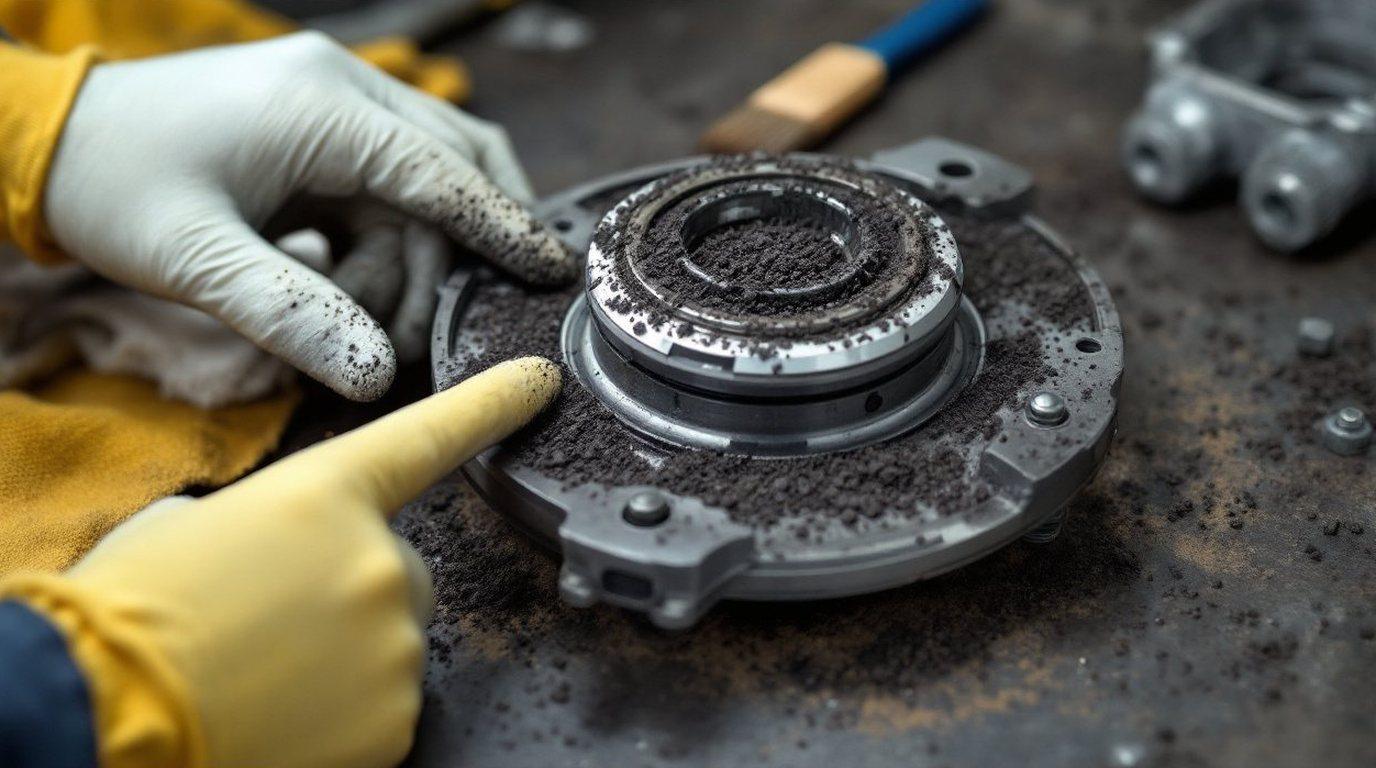
On this line, the failure on file is not inside the module at all. Each wheel bearing hub carries a magnetic encoder ring, a band of alternating north and south poles that turns with the wheel, and the wheel-speed sensor counts the poles as they pass. Iron particles from brake wear, rust and the road are drawn to the magnetized ring and pack between the poles, blurring the pattern the sensor reads. The EBCM sees one corner's speed turn erratic, sets that corner's code and shuts down the functions that rely on it.
GM's diagnosis for C0035 to C0050 with symptom byte 18, 5A or 0F is that this debris is the cause in most cases, and that cleaning the ring clears the codes without replacing the EBCM. Replace the module for one of those codes and the same warning can return on the first drive, because the dirty ring is still on the hub.
When the module itself fails, the fault is electronic: the stages that drive the pump motor and valve coils, the internal supply, the processor, the network circuit, and the joints between board and coils, all aging through years of heat cycles. That kind of failure shows up as no communication, codes that do not trace to one corner, or pump and valve faults that return after clearing.
Other parts light the same lamps: the wheel-speed sensors, their wiring and connectors at each corner, an encoder ring that is cracked rather than dirty (on many hub designs the ring is part of the bearing, so that means a new hub bearing), the pump motor, and the valves inside the hydraulic block.
Check these before you condemn the module
Work in this order. The first three steps can end the job without a module, a sensor or a hub.
1. Read every code with its symptom byte
Record each brake-module code with its symptom byte and the freeze-frame data before clearing anything, and note which corner each code names. A C0045 with byte 5A on the left rear is a different job from C0035, C0040, C0045 and C0050 all at once.
2. Watch the four wheel speeds
Graph all four wheel-speed readings on a slow, straight drive. Healthy readings track together. The debris case shows as one wheel whose reading drops out, spikes or lags the others, while a reading that stays dead from the first turn of the wheel points at the sensor or its circuit instead.
3. Inspect and clean the encoder ring
This is the step GM's diagnosis rests on. On many hub designs the ring sits on the inboard face of the bearing, behind the sensor tip, and reaching it means removing the sensor or the hub bearing itself, so follow the service procedure for that corner with the vehicle safely on stands.
Look for a dark, fuzzy coat of metal particles on the ring. Wipe it away with a clean, lint-free cloth or a soft nylon brush, and clean the sensor tip as well. Keep magnets, wire brushes and abrasives away from it, because a scratched or bent ring cannot be put right by cleaning. A ring that is cracked, chipped or missing segments needs replacing, which on a ring built into the bearing means a new hub bearing.
Clear the codes and drive. If the warnings stay off, the module was never the problem.
4. Sensor, wiring and connector at that corner
If the code comes back, inspect the sensor and its lead for chafing, look for green corrosion in its connector, and test the circuit the way the service information describes for the symptom byte you read.
5. Power, ground and communication
For codes on several wheels, or a module that will not answer, load-test the battery and check the ABS fuses in the underhood block from both sides. Clean the module's ground, then, with the battery disconnected, unplug the EBCM to look for water and pushed-back pins. Finally confirm battery feed, ignition feed and ground at the connector: a module that has all three, with its network wiring intact, and still will not respond, or that keeps setting codes after every wheel end checks out, is the one to send.
Have a mechanic do steps 3 to 5 if lifting the vehicle and pulling a hub are not your work, if the pedal or the red brake warning has changed, or if the warnings started after a crash, water damage or a jump-start. Keep your notes from step 1: the order form asks what your scan tool showed and what the vehicle is doing.
Repair, refurbished, used or new: what each really costs
Our figures are starting prices; work beyond the service is priced and agreed with you before it starts.
| Option | Price | What it involves | After install |
|---|---|---|---|
| Clean the encoder ring | No module bought; a shop quotes its labor | GM's fix for C0035–C0050 with bytes 18, 5A or 0F | Clear codes, drive |
| Our repair (any-make repair; no unit family on this line) | From $499 | Your own EBCM, repaired at component level and returned with its coding | Clear the codes and road-test |
| Refurbished unit with your data cloned | From $950 | A refurbished unit matching your module, your VIN coding and configuration copied onto it, your original kept as the core with no separate core charge | Clear the codes and road-test |
| Used unit | Varies | No history, coded to another vehicle | Ask the installer what setup it needs |
| New GM module | No price on file | Ordered by VIN at a GM parts counter | Find out from the installer whether it needs programming, and the cost |
Shipping and bench time, chosen at checkout:
| Leg | Option | Price |
|---|---|---|
| Label to the lab | USPS ground, bought by us and emailed after payment | Included |
| Label to the lab, rush inbound | UPS 2nd Day Air | +$55 |
| Return to you | Standard service, three to five business days | $29.95 |
| Return to you | UPS 2nd Day Air | $54.95 |
| Return to you | UPS Next Day Air | $94.95 |
| Bench time | About a week | Included |
| Bench time, rush repair | 2–3 business days | +$100 |
Every repair and refurbished unit includes a 1-year warranty, described on the warranty page.
When a module is beyond repair, we say so before doing anything else. You then choose between a refurbished unit, paying only the difference from what you already paid once we confirm it, and the return of your own module with a refund of the repair price, less shipping and a $150 bench evaluation fee. No unit ships ahead of your original, because the data a refurbished unit needs is read out of it.
Order through the any-make ABS repair. If the label is unreadable or you want the unit confirmed first, send a photo through request a quote; the unit families page shows how units identified on arrival are priced.
Removing and shipping the module
Brake work is safety work. If you are not equipped for it, a shop can pull the unit for you, and a crossover with an open brake line stays parked until the line is closed and bled.
- Photograph the unit and its label first. Send the photos through the quote form, and the reply tells you what to remove.
- Disconnect the battery. Negative cable off and key out before the connector is touched.
- Release the connector lock fully, then pull the plug straight off; levering it cracks the lock.
- If the module separates from the hydraulic unit, remove only the module and leave every line on the vehicle, which means no bleed for the removal.
- If it does not, remove the complete assembly, cap each port the moment its line comes off, keep the unit upright, and plan for a full bleed at refit.
- Pack it in a sealed bag, inside two inches of padding on every side, with the RMA number on the carton and on a slip inside.
- Ship it promptly. The prepaid label comes by email after payment; one still unused 20 days later is canceled and refunded, and we email you about a new one. The mail-in instructions cover packing step by step.
What happens at the bench
Once the box is opened, the module is checked against its RMA and its label read, which is also when a line with no unit family gets its identification. Next it goes on the bench under power: we pull its memory, including the codes it logged in your crossover, and load the circuits that drive the pump motor and the valve coils before any repair begins. A fault found is repaired on your own board at component level, the module is retested the same way, and it ships with its coding as it arrived; one that cannot be saved is set aside until you choose what happens next. How it works describes each step.
After it is back in the car
Refit the module or assembly exactly as removed, reconnect the battery and clear the codes. If the hydraulic unit came out, bleed the brakes completely first, using the scan tool's automated bleed wherever the GM procedure lists one for the Lambda. Some vehicles still need a brake bleed, initialization or calibration after install. Whether a new GM module needs programming, and at what cost, is the installer's call.
Then drive a short loop with the scan tool graphing all four wheel speeds: they should track together, and the three warnings should stay off. If you cleaned an encoder ring, look at it again whenever that corner's brakes are serviced, since particles that built up once can build up again.
Part numbers for the Acadia, Traverse, Enclave and Outlook
Before ordering, run the number printed on your module through the part-number lookup.
| Part number | Note |
|---|---|
| 25840308 | GM catalog: Electronic Brake And Traction Control Module Kit; 2009–2011 Traverse, 2007–2011 Acadia, 2009–2011 Enclave (3.6L) |
| 25840309 | GM catalog: the same kit; 2009–2011 Traverse, 2007–2011 Acadia, 2009–2011 Enclave |
| 25895780 | GM catalog: Electronic Brake And Traction Control Module Kit, 2008 Enclave |
| 20761339 | GM catalog: Electronic Brake Control Module, 2012–2017 Traverse, Acadia and Enclave (3.6L) |
| 20761340 | GM catalog: Electronic Brake Control Module, 2012–2017 Traverse, Acadia and Enclave (3.6L) |
| 0265950868 | Supplier number, 2008–2011 Enclave 3.6 ABS pump and control module assembly |
| 0265230111 | Supplier marking on the pump and module assembly; 2008–2011 Acadia, 2009–2011 Enclave and Traverse, 2008–2010 Outlook |
| 25840323 | ABS pump and module assembly; 2008–2011 Acadia, 2009–2011 Enclave and Traverse, 2008–2010 Outlook with variable assist power steering |
Five more assembly numbers are on file with the same fitment: 25895779, 25895784, 25812789, 25829830 and 15822755. All six are listed for vehicles with variable assist power steering, so a vehicle without that option may carry a different number. The kit numbers and the assembly numbers also describe different things, the module alone versus pump and module together, which is one more reason to buy by label rather than by model year.
GM's full-size trucks and SUVs of the same period are covered in our Silverado, Sierra and Tahoe EBCM guide.
FAQ
How much is an ABS module repair on a GMC Acadia?
Our repair of a 2007–2017 Acadia's electronic brake control module starts at $499, and a refurbished unit with the Acadia's data cloned onto it starts at $950, with return shipping from $29.95 added at checkout. Read the wheel-speed codes first, though. If they carry symptom byte 18, 5A or 0F, GM's fix is cleaning a wheel bearing's encoder ring, not a module.
What does C0035 mean on a Chevy Traverse?
C0035 is the left front wheel speed sensor fault, stored by the Traverse's brake module when the left front signal stops making sense. With symptom byte 18, 5A or 0F, GM's diagnosis is metal debris on that wheel's magnetic encoder ring in most cases, and cleaning the ring clears the code. With any other byte, diagnose the sensor and its circuit.
Can metal debris on a wheel bearing cause Service StabiliTrak on an Acadia?
Yes. GM's diagnosis for the wheel-speed codes C0035 to C0050 with symptom byte 18, 5A or 0F is ferrous debris stuck to the magnetic encoder ring on the hub, and cleaning the ring clears the codes without replacing the EBCM. The warnings that come with it are ABS, Service Traction Control or Service StabiliTrak.
Do I need a new wheel speed sensor or hub bearing for an Enclave ABS code?
Not before the encoder ring has been cleaned and inspected. On an Enclave, a wheel-speed code with symptom byte 18, 5A or 0F is first a cleaning job; a new hub bearing is needed when the ring is cracked or damaged, and a new sensor when the sensor or its circuit tests bad. Reading the symptom byte before buying parts keeps good bearings on the vehicle.
Is the Buick Enclave ABS module the same as the Acadia and Traverse module?
GM's catalog shares numbers across the three: 25840308 and 25840309 for the 2007–2011 Acadia and 2009–2011 Traverse and Enclave, and 20761339 and 20761340 for all three from 2012 to 2017. The 2008 Enclave has its own kit number, 25895780. Match the number on your module's label rather than the model name.
Can I drive an Acadia with the ABS and StabiliTrak warnings on?
With the module in place and no brake line opened, an Acadia, Traverse or Enclave showing these warnings still brakes, but without anti-lock, traction or stability assistance, so leave more room and avoid hard stops on wet or loose surfaces. Have it checked soon. Do not drive it if the red brake warning is on, the pedal feels different or the fluid is low.
Does a repaired Acadia or Traverse ABS module need programming?
Your own Acadia or Traverse module keeps its stored configuration through the repair, and a refurbished unit is loaded with the data read from your original before shipping. After installing either, clear the codes and follow any setup the GM procedure or scan tool calls for. Buy a new GM part instead and the installer decides whether programming is required, and at what price; this lab offers neither programming nor on-vehicle work.
What happens if the Traverse ABS module cannot be repaired?
A Traverse module found past repair stops the job, and we tell you before anything else is done. You then choose a refurbished unit with your Traverse's data cloned onto it, paying only the difference once we confirm it, or the return of your own module with a refund of the repair price, less shipping and a $150 bench evaluation fee. Your original stays with us as the core only when a refurbished unit is made.
How long will my Enclave be without its ABS module?
An Enclave's ABS module is away for the trip to Arlington, Texas, about a week on the bench and the return trip, or 2–3 business days on the bench with rush repair for +$100. Whether the Enclave can be driven in the meantime depends on what came out: with a brake line opened, it cannot.
What warranty comes with an Acadia or Traverse ABS module repair?
Every repair and refurbished unit for the Acadia, Traverse, Enclave and Outlook comes with a 1-year warranty on our work, from the day it ships back, at no added charge. That single warranty applies to everyone; it covers our repair or the unit we supplied rather than sensors, hubs or wiring.
Sources
- GM parts catalog, Traverse brake module listing: https://www.gmpartsgiant.com/oem-chevrolet-traverse-abs_control_module.html
- GM parts catalog, Enclave brake module listing: https://www.gmpartsgiant.com/oem-buick-enclave-abs_control_module.html
- GM bulletin behind the C0035–C0050 definitions and the encoder-ring diagnosis for this line, NHTSA copy of record: https://static.nhtsa.gov/odi/tsbs/2014/MC-10246913-9999.pdf