Mercedes Sprinter ABS / ESP Module Failure and Repair Guide
ABS Module Lab Team · · updated · 16 min read
Why the Bosch 8.0 ABS / ESP unit on 2007–2018 Sprinters fails (C1300, C1963, pump running, no communication), what repair costs and how fleets cut downtime.

The ABS / ESP control unit on a 2007–2018 Sprinter — the NCV3 van, chassis 906 — is a Bosch 8.0 unit, and when it fails the van tends to tell you in one of three ways: the ABS and ESP lamps stay lit, the pump runs when it has no reason to, or the scan tool cannot reach the module at all. We repair the control unit from $499 and return it with its coding untouched, or clone your van's data onto a refurbished unit from $950, and with rush options on the bench and on both shipping legs a working van can be back on its route in days. Start by reading the codes; C1300 and C1963 are the two our sourced data ties to this failure.
Which Sprinter vans have this ABS unit
The second-generation Sprinter — chassis 906 to Mercedes-Benz, NCV3 to the trade — covers the 1500, 2500 and 3500 from the 2007 through the 2018 model year in the United States, and because the same van wore Dodge and Freightliner badges our vehicle line carries all three names: /vehicles/mercedes-benz/sprinter/. The earlier T1N Sprinter of 2002–2006 is not on it, because the only source we found gave Bosch numbers with no clear US fitment.
The unit is identified as Bosch 8.0 by a German parts reference covering the W906 from 2006 to 2018, which lists the Bosch control-unit numbers in the table below and the Mercedes numbers A0064310812 and A0084315512. Two independent US repair listings split the run by year: one names Bosch 0 265 9xx numbers for 2007–2012 vans, the other 0265956378 and the Mercedes numbers 906-900-14-03 and 906-900-15-03 for 2014–2018 vans. The 2013 model year falls between the two, and no page we hold ties the 2014–2018 number to a Bosch generation outright; the German reference's year range through 2018 is the basis for treating the whole run as one unit in our Bosch ABS / ESP 8 family.
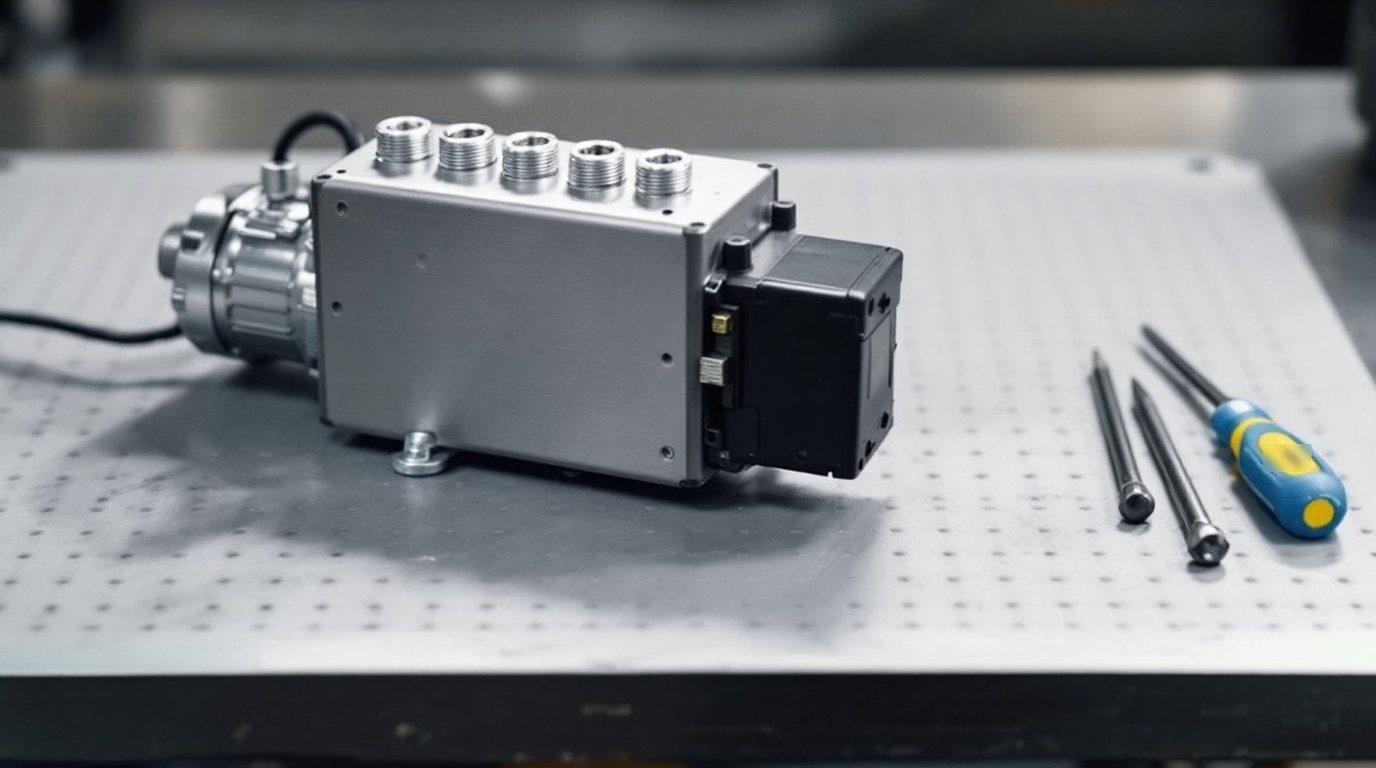
Bosch builds this generation as a hydraulic unit — pump motor and valve block — with the electronic control unit bolted to it in the engine compartment; on many of these units the control unit unbolts from the block without opening a brake line, and that is the piece we need. The white Bosch label carrying the 0 265 number is on the control unit.
Symptoms of a failing ABS module on the Sprinter
The symptom list our sources attach to this unit is unusually specific. The 2007–2012 repair listing addresses an ABS pump that runs constantly, speedometer malfunctions, lost communication with scan tools, and the codes C1300 and C1963. The German reference adds a permanent ABS / ESP warning light, no communication with the diagnostic tester, wheel-speed sensor faults despite good sensors, and the pump motor running continuously.
The constantly running pump is the symptom drivers notice first, because it is audible: a whine from the engine bay with the ignition on, sometimes continuing after the key is out. The module's pump driver has latched on or its relay has welded, and left alone it drains the battery overnight and burns out the pump motor, so pull the ABS pump fuse until the module is out.
The speedometer complaint is the one that confuses people: the wheel-speed signals it depends on come through the ESP control unit, so a module that stops processing them can leave the speedometer dead or erratic — a module suspect, not a cluster suspect. Wheel-speed sensor faults on good sensors are a quieter version of the same thing, the module's input stage reporting a sensor problem that is not there; a wheel-speed code that survives a new sensor moves the module to the top of the list.
The fault can begin intermittently — lamps on after an hour of highway, off again the next cold morning — and settle into a permanent state over weeks. Service brakes work throughout, but the van has no anti-lock, no traction control and no stability intervention, and on a loaded van that is a larger loss than on a car.
The fault codes you will see
Two codes are tied to this unit in our sourced data, and they are the ones to look for first. Read them with a tool that addresses the ESP control unit on this chassis; a generic reader sees the engine controller only.
| Code | Meaning | What it points to |
|---|---|---|
| C1300 | Pump motor circuit | The pump-motor driver or relay inside the control unit, the pump motor, or the supply and ground to the pump; with the pump running constantly, the driver stage in the module |
| C1963 | Stability control inhibit warning | The ESP function has been switched off by the module because of another fault it holds — read the rest of the memory, and if nothing else is stored, the module's own self-check |
Around those two you may see wheel-speed sensor codes on sensors that test good, which the German reference lists as a symptom of this unit, and supply-voltage codes, which belong to the battery and charging system. A van fitted with a second, house battery can show healthy voltage at the dash while the starting battery that feeds the ESP unit sags under the pump's load.
Then there is the module that does not answer: no communication with the ESP control unit, a lost-communication fault in the other modules, and the ABS and ESP lamps on because the van has lost the module. Our sources list lost communication for this unit directly — but a blown fuse, a corroded ground or water in the connector produces the identical picture, so run the checks below before you remove anything.
Why these modules fail
The pattern across the symptoms — pump running continuously, speedometer malfunction, no communication, phantom wheel-speed faults — describes a control unit whose output and input stages are failing one at a time: the pump driver and its relay switch the highest current in the unit and fail toward "on", while the communication and wheel-speed input stages fail toward silence. Bolted to a hydraulic block in a van that idles for hours in summer heat and runs salted roads in winter, the board-to-coil connections and power components age.
Separate the module from the things it is often blamed for:
- Wheel-speed sensors and their rings. A genuine sensor fault names one wheel and shows a bad trace in live data; the module fault that mimics it survives a new sensor.
- Harness and grounds. Corrosion at the connector and ground points produces intermittent power and network faults that look like a dying module.
- The pump motor. Worn brushes or a dragging armature can set C1300 and draw the supply down, and a module that has run it continuously may have cooked it; the bench runs the pump circuit under load to tell a motor from a driver.
- The hydraulic block. Sticking valves change pedal feel or make one wheel drag, and that is hydraulic work.
A control unit that cannot be reached with power and ground proven at its connector, or that reports faults on sensors proven good, has an electronic fault — the kind a component-level repair on the original board corrects.
Check these before you condemn the module
For a fleet, these checks are the difference between a van down for an afternoon and a van down for a week.
- The right battery, under load. Test the starting battery the ESP unit is fed from, not an added house battery, and check charging voltage; low supply during the pump's self-test can look like a module fault.
- Fuses. Test the ABS pump fuse and the ESP control-unit ignition fuse for voltage on both sides with the key on, and if the pump has been running constantly pull the pump fuse now.
- Grounds. Clean the module's ground point and the main engine-to-body grounds; an upfit, a lift gate or a refrigeration unit wired in can have disturbed them.
- The connector. Battery disconnected, lever released, inspect both halves for water, green corrosion and pushed-back pins, then dry and reseat it.
- Wheel-speed live data. Roll the van with the tool graphing all four wheels; clean, matching traces plus wheel-speed codes is the module, one bad trace is that wheel.
- The communication test. Key on, address the ESP control unit; no answer with battery and ignition voltage at the connector and a good ground points inside the module.
Involve a mechanic if the brake pedal has changed, if the lamps followed a collision, a flood or a jump-start, or if you are not set up to back-probe a connector safely. When the van is ordered in, our form asks for the codes from the scan tool and a description of what the module is doing — both required — and the order's status page takes a photo of the scan afterwards.
Repair, refurbished, used or new: what each really costs
| Option | Starting price | What it is | After installation |
|---|---|---|---|
| Our repair (Bosch 8 family) | From $499 | Your own control unit repaired at component level and load-tested, with its coding as it left the van | Clear codes and drive; bleeding only where a line was opened |
| Refurbished unit loaded with your van's data | From $950 | A tested Bosch 8 unit written with your van's VIN, coding and configuration; the original stays with us as the core | As for a repair |
| Used unit | Varies | A module from another van, coded to that van, with no history | Dealer coding where the tooling allows it; a configuration mismatch leaves the lamps on |
| New unit from a dealer | Not in our sourced data for this unit — price it by VIN at the parts counter | A blank unit | Dealer coding and configuration |
Starting prices mean exactly that: if the bench finds more than the service covers, the cost reaches you first and you decide. Return tiers are $29.95 (standard, 3–5 business days), $54.95 (UPS 2nd Day Air) and $94.95 (UPS Next Day Air), and the label into the lab is bought by us after payment, USPS ground unless you add UPS 2nd Day Air for +$55. About a week on the bench is standard; rush repair is +$100 for 2–3 business days. A 1-year warranty on our work is included with either service, from the day it ships, as the warranty page sets out. Return labels are insured for the price of the service.
When a unit is past repair the work stops and you choose: a refurbished unit for the price difference, confirmed beforehand, or your own unit back and the repair price refunded minus shipping and a $150 bench evaluation fee. No refurbished unit leaves before your original has arrived, because its data is read from yours.
Downtime, and how a fleet shortens it
A van's time off the road is the sum of three legs: transit to Arlington, Texas, time on the bench, and transit back. At the slowest that is ground shipping each way plus about a week on the bench; at the fastest it is UPS 2nd Day Air to us (+$55), 2–3 business days on the bench with rush repair (+$100), and UPS Next Day Air back ($94.95) — roughly a business week door to door for about $250 in options. Every step from the inbound label to the return tracking arrives by email, and the track repair page shows the same timeline to anyone with the link, so a dispatcher can watch it without calling. Removing only the control unit keeps the brake lines sealed, so the van can be moved around the yard while the unit is away, though it should not carry a route without ABS and ESP.
Order at start a repair and choose the Bosch 8 family, or send the label photo through request a quote for confirmation first; the family page lists the other vehicles that share this unit.
Removing and shipping the module
Engine cold, key out, negative battery cable off — and on a van that has been running its pump constantly, pump fuse out first. If any of this is unfamiliar, have a shop remove the unit; a van is never driven with a brake line open.
- Photograph the label before you start. The white Bosch label on the control unit shows the 0 265 number; include any Mercedes A-number printed on the unit. That photo confirms the unit before it ships and is what we match to your RMA.
- Release the connector. Lift the locking lever through its full travel and let it push the connector off; pulling against a half-open lever damages the pins.
- Unbolt the control unit from the hydraulic block. On many of these units it is held by fasteners around its edge and comes straight off, leaving the valve stems in the block and the lines untouched, so no bleed is required later.
- If it will not separate, do not force it: send the whole hydraulic unit, cap each line port the moment the line is off, keep it upright, and plan a full bleed with a tool that can cycle the valves.
- Pack it. Bag the unit, cushion it, and box it with padding on every side, the RMA marked on the box and repeated on a slip inside; the mail-in instructions show the packing.
- Ship with the label we send. It arrives by email after payment; print, tape, and hand the box to the carrier.
What happens at the bench
The unit is logged against its RMA, its label photographed and its numbers recorded, then powered on the bench so the stored data and fault memory can be read before the first test. The pump-motor and valve circuits are driven under load — the test that shows a pump driver that has latched on or a stage that has gone quiet — and the fault is repaired at component level on your own board, with your coding left exactly as it came in. If the unit cannot be repaired the job stops until you have chosen a refurbished unit or the return of your module. A repaired unit is load-tested again, packed, and shipped at the speed on your order. How it works describes the sequence.
After it is back in the car
Seat the control unit squarely over the valve stems, tighten the fasteners evenly, lock the connector, refit the pump fuse if you pulled it, and reconnect the battery. Clear the codes and drive the van above walking speed so the module reads all four wheels and completes its self-test; the lamps should go out within the first stretch of road.
If the hydraulic unit was removed, bleed all four corners with a tool that can cycle the ABS valves. A repaired module keeps the coding it arrived with, and a refurbished unit is loaded with your van's data before it ships, so the module itself needs no dealer visit. Installation still follows the vehicle maker's procedure all the same: some vehicles still need a brake bleed, initialization or calibration after install. A lamp that returns after a proper drive should be read, noted with the conditions, and reported to us before the unit comes out again.
Part numbers for the Sprinter
Bosch control-unit numbers are ten digits printed as 0 265 xxx xxx on the white label, often written without the spaces; the Mercedes numbers for the same unit are A0064310812, A0084315512 and, on 2014–2018 vans, 906-900-14-03 and 906-900-15-03. The table lists twelve Bosch numbers from our sourced data (a further reference, 2265106513, is listed for the 2014–2018 van in a format our sources do not explain); any of them can be entered in the part-number lookup.
| Part number | Note from our sourced data |
|---|---|
| 0 265 950 481 | 2007–2012 Sprinter 1500/2500/3500 ABS / ESP control module (US repair listing) |
| 0 265 951 522 | 2007–2012 Sprinter 1500/2500/3500 (same listing) |
| 0 265 951 524 | 2007–2012 Sprinter 1500/2500/3500 (same listing) |
| 0 265 951 520 | 2007–2012 Sprinter 1500/2500/3500 (same listing) |
| 0 265 951 108 | 2007–2012 Sprinter 1500/2500/3500 (same listing) |
| 0 265 956 033 | 2007–2012 Sprinter 1500/2500/3500 |
| 0 265 900 043 | 2007–2012 Sprinter 1500/2500/3500 |
| 0265950505 | Bosch 8.0 ABS / ESP control unit, Sprinter W906 (2006–2018), from the German parts reference |
| 0265951521 | Bosch 8.0 ABS / ESP control unit, Sprinter W906 (2006–2018) |
| 0265951856 | Bosch 8.0 ABS / ESP control unit, Sprinter W906 (2006–2018) |
| 0265951860 | Bosch 8.0 ABS / ESP control unit, Sprinter W906 (2006–2018) |
| 0265956378 | Bosch number for the 2014–2018 Sprinter 2500/3500 ABS module and pump |
FAQ
How much does Sprinter ABS module repair cost?
Repair of the Sprinter's Bosch 8.0 control unit starts at $499, a refurbished unit with your van's data cloned onto it starts at $950, and return shipping is added from $29.95. Anything the bench finds beyond the service is quoted before it is done; rush repair is +$100, and the 1-year warranty is already in the price.
Why does the ABS pump on my Sprinter run all the time?
A pump that runs with the key on and the brakes untouched, or keeps running after the key is out, is being driven by a pump stage in the control unit that has latched on or a relay inside it that has welded. Left alone it flattens the battery and overheats the pump motor, so pull the ABS pump fuse until the module is repaired; C1300 usually accompanies it.
Can the Bosch 8.0 unit be repaired rather than replaced?
Yes. The failures our sources list — pump driver stuck on, no communication, speedometer dropout, phantom wheel-speed faults — are failures of the electronics on the control unit's board, and those are repaired at component level on your own unit, which keeps its coding. A refurbished unit is offered only when the board is damaged beyond repair, and you are told before that decision is made.
Will the module need dealer coding after the repair?
Not for the module: a repaired unit keeps the coding it arrived with, and a refurbished unit is written with your van's VIN, coding and configuration before it leaves. Clear the codes, drive, and confirm the lamps go out; a steering-angle sensor relearn is the extra step some ESP vans ask for after a battery disconnect.
Can the van be driven while the module is out?
If only the control unit was removed and the brake lines were never opened, the service brakes work and the van can be moved, but it has no ABS, traction control or stability control and should not run a route in that state. If the hydraulic unit came out and a line was opened, the van does not move until the unit is back and the brakes are bled.
What if the unit cannot be repaired?
We stop and contact you first. You choose a refurbished Bosch 8 unit with your van's data cloned onto it, paying only the difference between its price and what you already paid once we have confirmed the amount, or the return of your unit with the repair price refunded minus shipping costs and a $150 bench evaluation fee. When a refurbished unit is made your original is kept as the core; otherwise it comes back to you.
Is a Dodge or Freightliner Sprinter the same unit?
Our vehicle data carries the 2007–2018 Sprinter as one line under all three badges, because the chassis and the Bosch 8.0 unit are shared. The label on your control unit — the 0 265 number and any Mercedes A-number — is what identifies it, not the badge on the grille; send a photo through the quote form if your number is not one we list.
Sources
- Our sourced data for this van comes from two independent US repair listings (the 2007–2012 and 2014–2018 part numbers, the codes C1300 and C1963, and the symptom list) and a German parts-reference page that names the W906 unit as Bosch 8.0 and lists the Bosch and Mercedes part numbers for 2006–2018. None of those hosts is on our list of neutral sources, so they are described here rather than linked.
- Prices, turnaround, shipping tiers and warranty terms are the site's own policies, stated on the pricing, how it works and warranty pages.