How Can I Confirm Compatibility Before Ordering a Refurbished ABS Module
ABS Module Lab Team · · 11 min read
Match your ABS module's exact part number and VIN to confirm compatibility before ordering a refurbished unit, since year and model alone don't guarantee a…
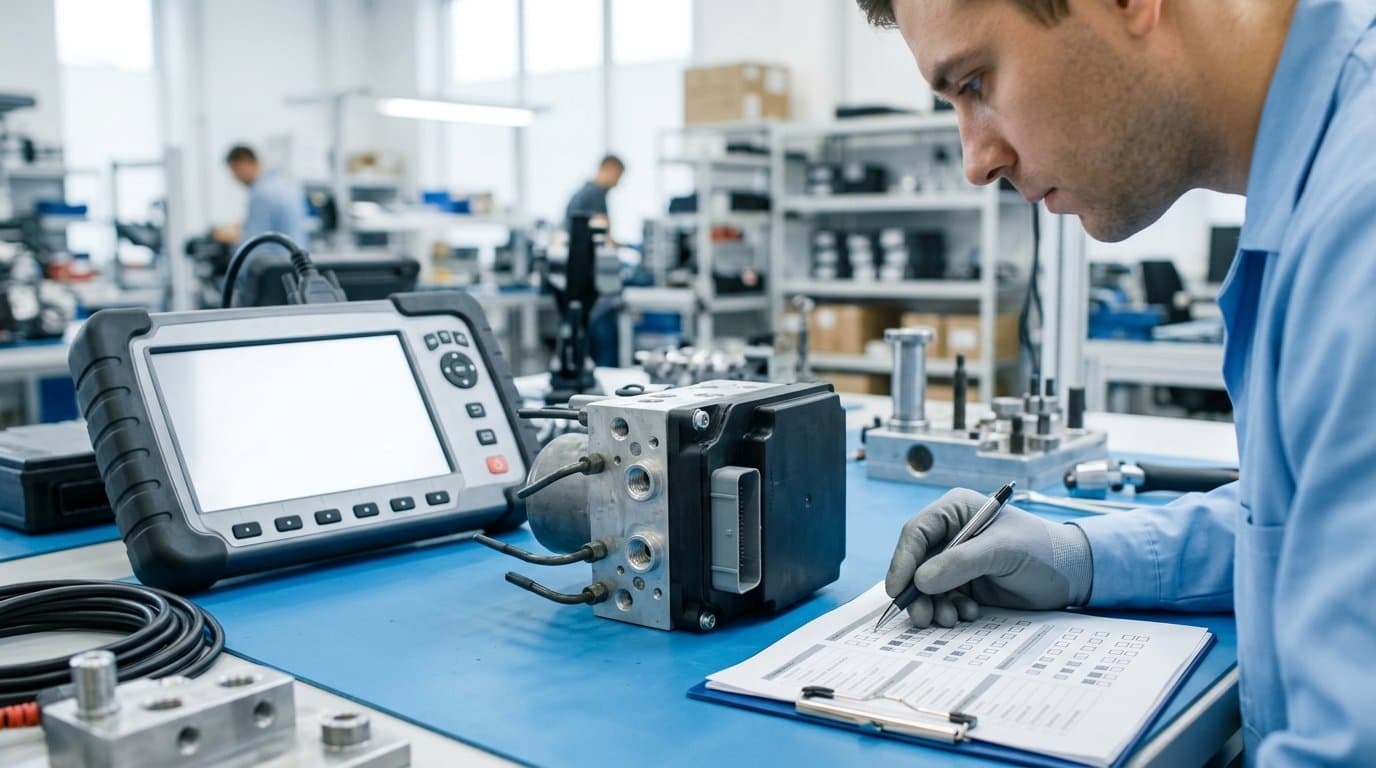
Confirming compatibility before ordering a refurbished ABS module requires matching the exact part number stamped or printed on your current module's label and cross-referencing it against your vehicle's VIN. The part number identifies the controller family, communication protocol, valve configuration, and software version—factors that determine whether a refurbished unit will communicate with your vehicle's network and function after installation. Year, make, and model narrow the field but do not isolate a single compatible unit, because manufacturers installed multiple controller families within the same model year based on production date, trim level, option packages, and regional market requirements.
This article explains the verification steps that prevent ordering an incompatible module, identifies the questions that distinguish a properly matched replacement from a unit that will fail after installation, and describes how VIN cloning and coding requirements affect whether you can install a refurbished module without a dealer programming visit.
Why Part Number Verification Is the Only Reliable Compatibility Check
The part number on your ABS module's label is the sole reliable identifier for ordering a compatible refurbished replacement. Vehicle year, make, model, and engine size provide a starting point but do not specify which controller family the manufacturer installed in your particular vehicle. A single vehicle platform can use dozens of distinct part numbers, none of which are functionally interchangeable.
The 2007-2012 Nissan Altima, for example, used part numbers 47660-JA00A, 47660-JA10A, 47660-JA11A, 47660-JA20A, 47660-JA21A, 47660-JA30A, 47660-JA31A, and 47660-JA32A depending on engine type (QR25DE versus VQ35DE), transmission (manual versus CVT), and production date. These eight assemblies serve the same chassis code and body style but represent different controller families with incompatible valve configurations, sensor inputs, and communication protocols.
Ordering by vehicle description alone introduces a high probability of receiving the wrong controller family. The supplier may ship the most common variant for your model year, but if your vehicle was built with a different option code or during a mid-year production change, the module will not function. Evaluating a module without committing to a purchase requires providing both the part number and VIN to allow the supplier to confirm the exact controller family before a unit ships.
Where to Find Your ABS Module Part Number and How to Read It
Part numbers are stamped, printed, or labeled directly on the ABS module housing. On integrated units where the hydraulic valve block and electronic control unit form a single assembly—common on Toyota, Nissan, Lexus, and many platforms—the label appears on the side of the actuator body, often visible from under the vehicle or through the wheel well.
For modules with separate control units that bolt to a remote valve block, the part number appears on the electronic control unit itself, typically a metal or plastic enclosure mounted near the hydraulic assembly or elsewhere in the engine bay. Clean dirt, road grime, and corrosion from the label area before attempting to read the number; faded or partial numbers lead to misidentification and incompatible replacements.
Manufacturer part numbers follow distinct formats. Toyota and Lexus actuator assemblies begin with 44050- or 44540-, followed by a five-character suffix (such as 44050-02440 or 44050-48320). Nissan anti-skid actuator numbers follow the pattern 47660- plus a suffix (such as 47660-JA10A or 47660-9CE2D). Bosch modules manufactured for domestic and European vehicles display Bosch-assigned numbers beginning with 0 265 or 0 273, often accompanied by an OEM-specific number from the vehicle manufacturer.
If the label is illegible, the vehicle's original window sticker, build sheet, or dealer parts system query using your VIN will return the factory-installed part number. Some vehicles have the part number printed on a secondary label inside the driver's door jamb or under the hood on the emissions control information decal, though this practice is inconsistent and should not be relied upon as a primary source.
Cross-Referencing Part Numbers, Supersessions, and Vehicle Configuration Data
Once you have the part number, cross-reference it against published fitment data to confirm the controller family and identify any superseded or updated numbers. OEM parts catalogs, automotive parts databases, and service information systems maintain records of which part numbers were installed on specific vehicle configurations.
Published Toyota fitment data shows that actuator assembly 44050-02440 was installed on 2009-2011 Corolla models with VSC and a cutoff switch designated V2P, while 44050-02522 served the same platform from 2011-2013 without the V2P designation. The two numbers represent different software configurations and cannot be cross-installed even though the vehicles share the same chassis code and model year overlap.
Supersession records reveal when manufacturers replaced one part number with an updated version. Toyota part 44050-30260, originally fitted to 2006 Lexus GS300 and GS430 models, was replaced by 44050-30670. A supplier offering a refurbished unit must clarify whether they stock the superseding number and whether that unit retains backward compatibility with the original application, or whether your vehicle specifically requires the earlier number due to communication protocol differences.
When requesting a quote or placing an order, provide your VIN alongside the part number. The VIN allows the supplier to decode your vehicle's exact configuration—market, trim level, option codes, and production date—and confirm that the part number you read matches the vehicle's build specifications. Requesting an estimate with complete information prevents delays, mismatched parts, and surprise costs after your module reaches the supplier.
Nissan part 47660-ZR31B superseded earlier numbers 47660-7S320, 47660-ZH71C, 47660-ZH71B, and 47660-ZH220 for the 2004-2015 Titan. The superseding part serves as a replacement for all earlier versions in that family, meaning a refurbished unit carrying number 47660-ZR31B will install and function correctly in a Titan originally equipped with any of the superseded numbers.
However, not all supersessions are bidirectional. An updated part may require companion updates to other vehicle systems—wiring harness changes, sensor upgrades, or software calibrations—that were introduced mid-production. Installing a superseding part in a vehicle that lacks those updates may result in communication faults, incorrect fault codes, or degraded system performance.
Understanding VIN Cloning, Coding Requirements, and Why Advance-Exchange Programs Cannot Pre-Program Your Module
ABS modules store vehicle-specific configuration data: VIN, tire size, brake-circuit parameters, installed option codes, and region-specific safety settings. A refurbished module sourced from a different vehicle arrives with that donor vehicle's data programmed into its memory, and simply bolting it into your vehicle will trigger coding mismatches, communication faults, and system warnings.
Modern ABS modules can be re-flashed to match your vehicle's specific configuration. According to an independent repair case documented on CarPartSource, a used 2008 Ford Escape ABS module was successfully re-flashed by an independent repair shop after installation, restoring full braking function despite initial dealer claims that it could not be reprogrammed. This demonstrates that many controller families support reprogramming, though the specific tools and procedures vary by manufacturer and platform.
Some suppliers clone your original module's VIN and configuration data onto the replacement unit before shipping. This process requires the supplier to receive your original module first, extract the stored data using bench equipment, and write it into the refurbished unit's memory. The replacement then installs as a direct bolt-in component, though some vehicles still require brake bleed, initialization, or calibration procedures after installation per your vehicle's service requirements.
ABS Module Lab's refurbished module service uses this approach: your original module ships to the facility first, bench equipment extracts your vehicle's data, and the refurbished replacement returns with your VIN and coding already programmed. The business does not operate an advance-exchange program where a refurbished unit ships before you return your core, because data cloning cannot occur without physical access to your original module.
Modules that arrive without your vehicle's data already programmed require dealer-level or specialized diagnostic equipment to initialize after installation. The programming session writes your vehicle's VIN and configuration into the replacement module's memory, enabling it to authenticate with the body control module, instrument cluster, and other networked components. When comparing refurbished replacement with repairing your original unit, confirm whether the supplier performs data cloning as part of the replacement service or whether you will need to arrange dealer programming after installation.
Verification Questions to Ask Before Placing Your Order
Before placing an order, work through this verification checklist to confirm compatibility and understand what the supplier's refurbished module service includes.
Part identification and fitment
- What is the complete part number stamped on my module's label, including all suffix characters?
- Does your inventory include this exact part number, or are you offering a superseded replacement?
- If superseded, does the replacement require wiring, sensor, or software updates to function in my vehicle's configuration?
- What is the controller family designation for this part number?
Coding and programming requirements
- Does the refurbished module arrive pre-coded with my vehicle's VIN and configuration data?
- If yes, do I need to send you my original module first so you can extract and clone the data?
- If no, what programming equipment and access will I need to initialize the replacement module after installation?
- Are there additional initialization, calibration, or relearn procedures required after installation (steering angle sensor, brake-fluid initialization, pump prime)?
Core return and compatibility verification
- Do you confirm compatibility by inspecting my original module before shipping a replacement, or do you ship immediately based on my vehicle description?
- What happens if the refurbished module does not communicate or function after installation—do I pay return shipping, a restocking fee, or both?
- If my original module is unrepairable, do you offer a refund, or am I obligated to purchase a replacement at an additional cost?
Warranty and post-installation support
- Does the warranty cover failure of the refurbished module itself, or does it exclude failures caused by external wiring faults, corrosion, or contamination?
- If I install the module and discover it is not compatible with my vehicle due to incorrect fitment data, what is your return policy?
Reputable suppliers answer these questions directly with specific references to your vehicle's configuration and the module's part number. Evasive answers, vague assurances that "it will work," or claims that "all modules for your model year are the same" signal inadequate verification processes and a high probability of receiving an incompatible unit.
ABS Module Lab's refurbished module service identifies compatibility using your VIN and a photo of your module label, which you can submit for free confirmation before placing an order. Your original module ships to the facility first, allowing bench equipment to extract your vehicle's data and write it into the refurbished replacement before the unit returns.
Frequently Asked Questions About Confirming ABS Module Compatibility
Can I use a module from the same make and model if the part number is different?
No. Different part numbers represent different controller families, valve configurations, communication protocols, or software versions. Even modules from the same model year and trim level are not interchangeable if the part numbers differ. The part number on your module's label is the sole reliable identifier for ordering a compatible replacement.
What if my module's label is too corroded or faded to read the full part number?
Provide your VIN to a supplier that offers free module confirmation. The VIN decodes to your vehicle's exact build specification, allowing the supplier to look up the factory-installed part number. Alternatively, a dealership parts department can query your VIN in their system and return the original equipment part number.
Do refurbished modules come pre-programmed, or will I need a dealer visit after installation?
It depends on the supplier's process and the controller family. Modules that arrive with your original VIN and configuration data already programmed—cloned from your core—install without dealer programming, though some vehicles still need a brake bleed, initialization, or calibration after install. Modules shipped as advance-exchange or without data cloning may require dealer-level programming or specialized diagnostic equipment to initialize.
If a part number has been superseded, will the newer part work in my older vehicle?
Often yes, but not always. Superseding parts designed as backward-compatible replacements will function in vehicles originally equipped with the earlier number. However, some supersessions introduce design changes that require updated wiring, sensors, or software present only in later production vehicles. Confirm with the supplier that the superseding part is a direct replacement for your specific build date and configuration.
How do I know if the refurbished module supplier has the correct unit for my vehicle?
Ask the supplier to confirm your part number against their inventory and verify fitment using your VIN. A qualified supplier will reference published fitment data, supersession records, and vehicle configuration details before committing to ship a specific unit. Suppliers that accept orders based solely on year, make, and model without requesting the part number or VIN increase your risk of receiving an incompatible module.
Conclusion: Confirming Compatibility Prevents Installation Failures and Dealer Programming Surprises
Confirming compatibility before ordering a refurbished ABS module depends entirely on precise part-number verification, understanding controller-family distinctions, and confirming that the replacement unit will arrive with your vehicle's VIN and configuration data already programmed. Vehicle year and model provide a starting point, but production variations, option codes, and mid-year changes mean that dozens of part numbers may apply to a single platform, none of which are functionally interchangeable regardless of physical similarity.
Work from the part number stamped on your module's label, cross-reference it against OEM fitment data and supersession records, and provide your VIN to the supplier before placing an order. Ask explicit questions about data cloning, programming requirements, and the supplier's process for verifying compatibility before a unit ships. Suppliers that confirm your module family and part number before committing to an order reduce the risk of receiving a unit that will not communicate, initialize, or function after installation.
If uncertainty remains about which unit your vehicle requires or whether a refurbished replacement will install without dealer programming, request module confirmation before ordering. ABS Module Lab offers free confirmation when you provide a photo of your module's label and your VIN, allowing verification of the controller family and confirmation of availability for your specific configuration.