Where Can I Get an ABS Module Evaluated Without Buying a New Dealer Unit First
ABS Module Lab Team · · updated · 13 min read
Mail-in bench repair facilities evaluate ABS modules outside your vehicle to determine if repair is possible before you buy a new dealer unit.
Meta Description: Send your ABS module to a mail-in bench repair facility for evaluation before purchasing a replacement. No dealer visit required.
When your ABS warning light comes on and a dealer quotes you $1,500 or more for a new module, you need a reliable way to know whether your existing unit can be repaired before committing to that expense. The answer is straightforward: specialized mail-in bench repair facilities evaluate ABS modules outside your vehicle, testing the electronic control board and hydraulic components without requiring you to purchase anything upfront. ABS Module Lab operates as one such nationwide service, providing evaluation, repair estimates, and bench testing for major ABS controller families including Bosch, Continental (ATE/Teves), Kelsey-Hayes, TRW, Mando, and manufacturer-specific units from Toyota, Nissan, and Honda.
This evaluation process—called bench testing—removes the guesswork from ABS module failures by powering the unit, checking communication circuits, testing motor and valve drivers, and identifying specific component failures. You'll know whether your module is repairable, what the repair will cost, and whether a refurbished replacement makes more sense, all before spending money on a new dealer unit.
Why Evaluation Comes Before Purchase: The Bench-Testing Alternative
Dealers typically diagnose ABS faults through the vehicle's onboard diagnostic system, which identifies communication errors, sensor faults, or pump failures. But the vehicle's scan tool cannot test individual circuit board components, solder joints, or the actual electronic drivers inside the control module. A failing power supply, corroded circuit trace, or damaged valve driver looks identical to a completely failed module when scanned through the OBD-II port.
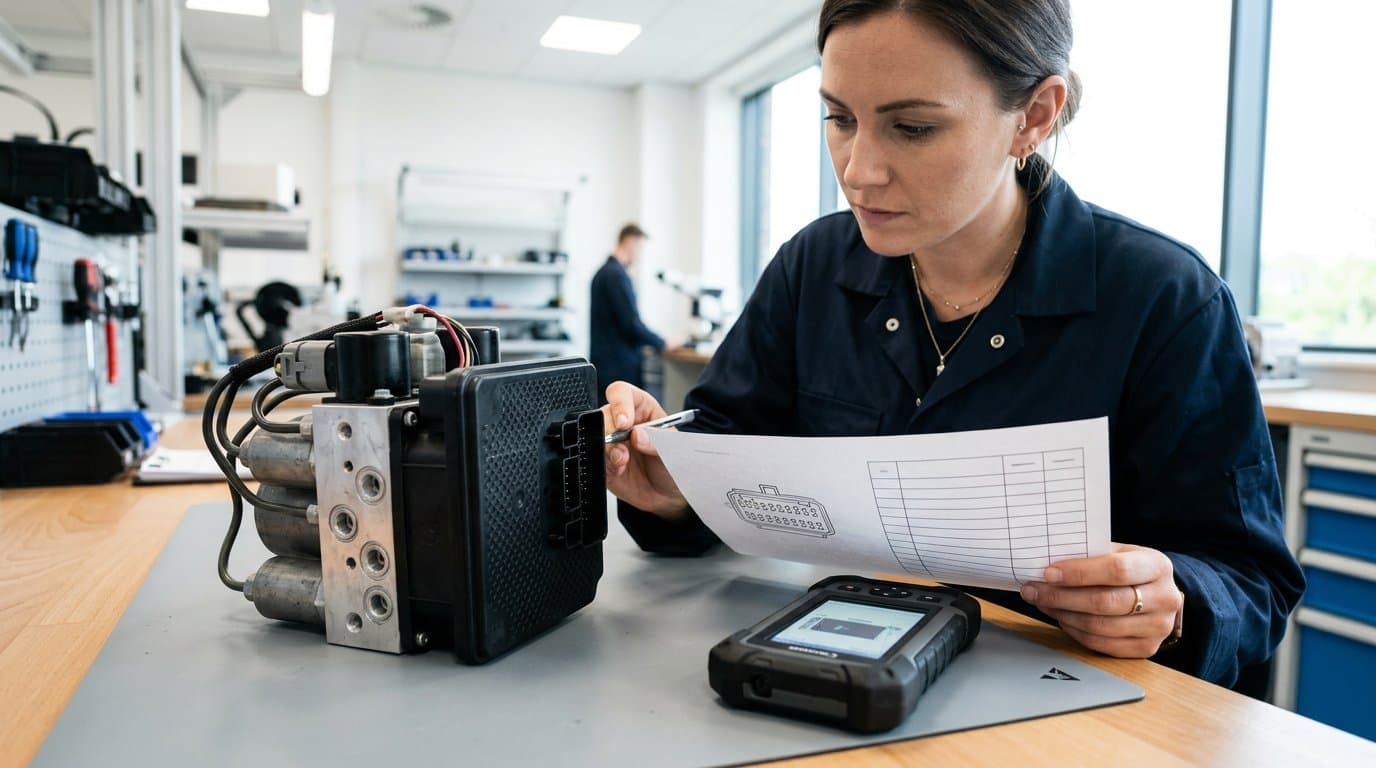
Bench testing bypasses this limitation by connecting the module to external power, ground, and communication lines outside the vehicle. The technician measures voltage at specific test points, triggers individual solenoid valves, activates the pump motor, and reads fault memory directly from the control board. This direct access reveals whether the problem stems from a replaceable component—a capacitor, relay, or transistor—or from unrepairable internal damage like a cracked circuit board or corroded hydraulic block.
The financial difference is significant. According to ABS Module Lab's published pricing, repair starts at $499 for most unit families (Kelsey-Hayes EBC325 units start at $325), while refurbished replacements with vehicle data cloned begin at $950. New dealer units for common vehicles range from $1,135 to over $1,700 for the part alone, based on October 2026 catalog pricing for units like the Bosch 8 family.
Bench evaluation also confirms that your ABS module is actually the problem. Wheel speed sensors, wiring harness breaks, and corroded ABS connectors produce identical warning lights. Sending the module for evaluation establishes whether the electronic control unit itself has failed or whether the fault lies elsewhere in the brake system.
What Information You Need Before Requesting an ABS Module Evaluation
The part number stamped or printed on your ABS module's label is the single most important piece of information for any repair estimate. This identifier—not the vehicle year, make, and model—determines which controller family your module belongs to, which components are inside, and what repair procedures apply. A 2008 Ford F-150, for example, used multiple ABS systems across its production run: Bosch 8.0 units, Bosch 8.1 (a smaller variant), and others depending on engine size and trim level.
Locate the part number on the module's metal or plastic label, usually visible without removing the unit from the vehicle. The format varies by manufacturer:
- Bosch systems: Seven to ten-digit numbers starting with 0265, often with a second application-specific number from the vehicle maker (e.g., 8K0614517AL for Audi, 7L3Z-2C219-A for Ford)
- Continental (ATE/Teves) systems: Part numbers beginning with letter-number combinations or purely numeric codes specific to the vehicle brand
- Toyota/Lexus: Five-digit codes starting with 44 or 47 (e.g., 44050-06070 for Camry, 44510-48190 for Highlander Hybrid)
- Nissan/Infiniti: Five-digit codes typically in the 476xx range for ABS actuator assemblies
- Kelsey-Hayes and TRW units: Alphanumeric codes tied to the vehicle manufacturer's part numbering system
Your vehicle identification number (VIN) provides the second critical data point. ABS modules store vehicle-specific coding, configuration parameters, and sometimes mileage or VIN data in non-volatile memory. The VIN confirms which software version, brake system variant, and regional specifications your module was programmed with. This matters because a bench repair facility can preserve or clone this data, eliminating the need for dealer reprogramming after installation.
Diagnostic trouble codes (DTCs) retrieved from the ABS system add useful context but are not required for an initial evaluation quote. Codes like C1095 (ABS hydraulic pump motor circuit failure), C1145 (right front inlet valve circuit), or C0265 (EBCM relay circuit) indicate which subsystem failed, helping the bench technician prioritize testing. However, the evaluation itself will generate its own test results independent of the vehicle's fault memory. For a complete discussion of what information improves estimate accuracy, see the ABS Module Repair Estimate Checklist.
Photographs of the module label provide an alternative when you cannot easily transcribe the part number. A clear image showing all text, barcodes, and manufacturer logos allows the repair facility to identify the unit before you ship it. ABS Module Lab accepts label photos by text message or email for pre-shipment identification.
Where to Send Your ABS Module for Evaluation: Mail-In Bench Repair Services
ABS Module Lab operates as a nationwide mail-in bench repair service, meaning you remove the module from your vehicle, ship it to the lab, and receive it back repaired or replaced. The business model differs fundamentally from mobile repair or in-shop diagnostics: the module undergoes evaluation on specialized test equipment designed for each controller family, outside the constraints of vehicle-mounted diagnostics.
The facility accepts modules from all fifty states. After placing an order online or confirming your module by phone, you receive a prepaid USPS Ground shipping label by email. You pack the module securely, attach the label, and drop it at any USPS location. For faster inbound shipping, UPS 2nd Day Air costs an additional $55. Standard turnaround is approximately one week on the bench after arrival; rush service places your module in the test queue within 2-3 business days for an additional $100.
Return shipping options include USPS Ground (3-5 business days) for $29.95, UPS 2-day for $54.95, or UPS Next Day for $94.95. These costs appear at checkout and apply to both repaired original modules and refurbished replacements.
The mail-in model provides access to bench expertise regardless of your location. Whether you're in New Haven, North Dakota, or Illinois, the evaluation process and pricing remain identical. No local shop visit is required, and no diagnostic fee applies for simply determining whether the module is repairable.
Before shipping, verify that your module is a conventional ABS/ESP unit and not a hybrid brake actuator. Hybrid vehicles from Toyota, Lexus, Kia, and some other manufacturers use high-pressure electro-hydraulic brake boosters rather than traditional ABS pump assemblies. These units require different bench procedures and are quoted individually. ABS Module Lab's hybrid brake actuator page explains the distinction and provides free quotes before any work begins.
How ABS Module Evaluation Works at a Bench Repair Facility
Bench testing begins with visual inspection and part-number confirmation. The technician photographs the module label, verifies it matches the order, and checks for obvious physical damage: cracked housings, corroded connectors, or signs of water intrusion. Modules with severe corrosion inside the hydraulic block or fire damage may be deemed unrepairable at this stage, though this determination is made before any paid work begins.
Next, the module connects to a bench power supply that replicates the vehicle's electrical system. The technician applies 12-volt power and ground, monitors current draw, and checks whether the control unit initializes. A module that draws excessive current immediately, fails to power up, or shows shorted internal circuits reveals power supply failures—often damaged voltage regulators, shorted capacitors, or failed microcontroller power pins.
Communication testing follows. Using a CAN bus interface or the manufacturer's diagnostic protocol, the technician attempts to read the module's identification, fault memory, and stored VIN data. Successful communication confirms the microcontroller and its associated circuits function. Communication failures indicate processor damage, corrupt memory, or failed transceiver chips, which may or may not be repairable depending on component availability and board complexity.
The hydraulic components undergo functional testing next. The technician energizes individual solenoid valves by sending commanded signals to the valve driver circuits, then measures the electrical response and listens for the mechanical click of each valve opening. Valve driver circuits contain transistors or MOSFETs that switch high current to the solenoids; these components fail from overcurrent, heat, or voltage spikes during normal operation. A driver circuit that shows infinite resistance, shorted to ground, or no switching action points to a specific failed component on the board.
Pump motor testing applies voltage to the motor terminals and monitors the current draw and motor response. A seized pump, worn brushes, or failed motor driver circuits produce characteristic electrical signatures. Some pump failures are mechanical—corroded commutators, stuck impellers—and cannot be repaired through circuit board work alone. The hydraulic block itself, a machined aluminum assembly with internal passages and check valves, is not typically repairable if internally corroded or cracked.
The evaluation produces one of three outcomes: the module is repairable with component-level work, it requires a refurbished replacement, or it falls outside the facility's capability and must go back to the customer. ABS Module Lab documents findings and contacts the customer with results and pricing before proceeding.
Evaluation Outcomes: Repair, Replacement, or Return
When the bench determines your module is repairable, the facility provides a firm price for the work. For most ABS controller families, repair pricing starts at $499, with the Kelsey-Hayes EBC325 family starting at $325. This base price covers typical failures: valve driver transistors, power supply capacitors, relay circuits, and solder joint reflowing. If testing reveals more extensive damage—multiple failed circuits, corroded board traces requiring jumper wires, or specialized component replacement—the technician quotes the additional cost and requests approval before doing that work.
The repaired module retains your vehicle's VIN, coding, and configuration because it is your original unit. No dealer programming visit is required after installation for the module itself, though some vehicles still need a brake system initialization, steering angle sensor calibration, or bleeding procedure depending on the manufacturer's requirements. The module includes a one-year warranty.
When the module cannot be repaired—due to internal hydraulic block damage, cracked circuit boards, or unavailable replacement components—ABS Module Lab stops and presents two options. First, a refurbished replacement: a tested unit of the same controller family with your VIN and configuration data cloned from your original. The refurbished module installs exactly like your original because it carries the same vehicle-specific programming. Replacement pricing begins at $950, and you pay only the difference from what you already paid for the repair attempt. The facility confirms the amount before proceeding.
Second, you can decline the replacement and have your original module returned unrepaired. In this case, ABS Module Lab refunds the repair price minus shipping costs already incurred. This policy is documented in the facility's published terms under "Refund stages," and ensures you are not charged for repair work that cannot be completed. The decision rests entirely with you; no additional charges apply without explicit approval.
For specialized units like Mercedes-Benz SBC (Sensotronic Brake Control) systems or hybrid brake actuators, the facility provides free quotes before anything ships. These units involve high-pressure accumulators, unique hydraulic architectures, or control systems that require different bench procedures. The quote stage confirms whether the facility can service the unit, establishes pricing, and sets expectations for turnaround time.
The evaluation itself costs nothing beyond the shipping to send your module to the lab. If you want confirmation before removing the unit from your vehicle, send a photograph of the label and your VIN to the facility first. ABS Module Lab provides this pre-shipment identification at no charge, confirming the controller family, typical failure modes, and expected repair cost before you commit to shipping.
Frequently Asked Questions About ABS Module Evaluation
Do I need to have my vehicle scanned before sending the module for evaluation?
No. While diagnostic trouble codes provide useful context, bench testing generates its own independent test results by directly measuring circuit voltages, communication integrity, and component function. If you already have codes from a prior scan, include them with your shipment, but they are not required for an accurate evaluation.
Can I drive my vehicle with the ABS module removed?
Most vehicles retain basic braking function without the ABS module, but the ABS warning light will remain on, anti-lock braking will not function, and on vehicles with electronic stability control (ESC), that system will also be disabled. Some modern vehicles integrate ABS function with brake-by-wire or advanced driver assistance systems; removing the module may disable those features or trigger additional warnings. Plan to have your vehicle stationary or arrange alternative transportation while the module is out for bench testing.
How long does the evaluation process take?
Standard turnaround is approximately one week on the bench after the module arrives at the facility. This includes the evaluation, any repair work approved, and testing before return shipment. Rush service reduces bench time to a 2-3 business day target for an additional $100. Total time from your door back to your door depends on inbound and return shipping methods selected.
Will my repaired module work in my vehicle without dealer programming?
A repaired original module retains all vehicle-specific coding because it is the same physical unit that came out of your vehicle. No dealer programming is required for the module itself. However, some vehicles require a brake system initialization procedure, steering angle sensor calibration, or ABS self-test after module installation; these procedures depend on the vehicle manufacturer's service requirements, not the module repair. A refurbished replacement module receives your VIN and coding cloned from your original, which likewise eliminates the need for dealer programming of the module.
What happens if the module is too damaged to repair or replace?
ABS Module Lab refunds the repair price minus shipping costs already incurred and returns your original module unrepaired. You receive this decision before any repair work is performed, and you choose whether to accept a refurbished replacement (paying only the difference in cost) or take the refund and explore other options.
Next Steps: Getting Your ABS Module Evaluated
If you know your module's part number, you can start a repair order online immediately. The system identifies the controller family, displays pricing, and generates a prepaid shipping label. If you're uncertain which ABS system your vehicle uses, or if the part number is difficult to read, send a clear photograph of the module label along with your VIN. ABS Module Lab confirms the unit at no charge before you remove or ship anything.
For vehicles with conventional ABS/ESP systems from Bosch, Continental, Kelsey-Hayes, TRW, Mando, or integrated manufacturer units from Toyota, Nissan, or Honda, the evaluation process is straightforward: ship the module using the prepaid label, receive test results within approximately one week, and approve or decline any repair or replacement based on firm pricing. The facility contacts you before performing work that changes the quoted price, and nothing proceeds without your explicit approval.
Hybrid brake actuators, Mercedes-Benz SBC units, and other specialized systems require an initial free quote. Contact the facility with your part number and VIN, and they will confirm whether your unit can be serviced and provide pricing before you ship. This ensures you know exactly what to expect for units outside the standard ABS module families.
Warranty coverage is one year on all repairs and refurbished replacements. The warranty covers the repaired or replaced module itself; installation labor, brake bleeding, or other service work performed at your end is outside the warranty scope.
The alternative to bench evaluation is purchasing a new dealer module, which costs $1,135 to over $1,700 for the part alone based on current catalog pricing for common units. That new module arrives uncoded to your vehicle and requires dealer programming, a service that adds further cost and requires a visit to a franchised dealership with factory diagnostic equipment. By contrast, a bench-repaired or refurbished module returns with your VIN and coding intact, reducing both cost and complexity.
If your ABS warning light is on and a dealer or shop has quoted you for a new module, request an evaluation first. The combination of firm pricing, preserved vehicle coding, and the option to return the module unrepaired if it cannot be fixed provides a clear decision path before committing to a new dealer unit. Whether the bench finds a $50 capacitor failure or determines your module needs a refurbished replacement, you'll know the actual condition and cost before spending money on parts or dealer programming.
Call ABS Module Lab at (817) 505-4201, text a photo of your module label, or email repairs@absmodulelab.com to confirm your module and begin the evaluation process. The answer to "where can I get an ABS module evaluated without buying a new dealer unit first" is simple: send it to a specialized bench repair facility that tests, quotes, and repairs controller families nationwide by mail.