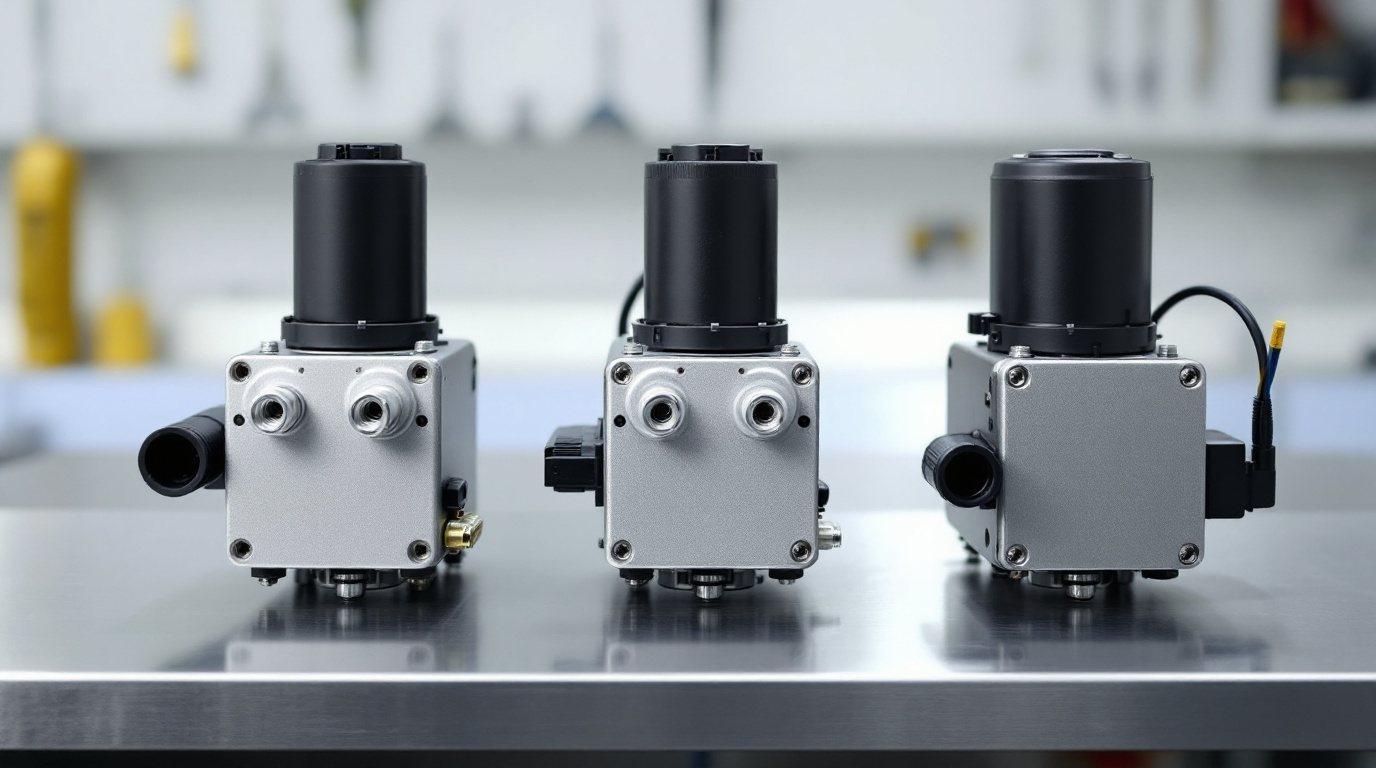
Volvo S60, S80, XC70, XC90 ABS Module Failure: BCM Codes and Repair
ABS Module Lab Team · · 17 min read
Which ATE unit your Volvo S60, S80, V70, XC70, XC90 or XC60 has, what BCM-0070 and the other BCM codes mean, and what a module repair costs.

On the Volvo S60, S80, V70, XC70 and XC90 the brake control module (BCM) is a Continental Teves (ATE) unit, and the faults on file follow two patterns: the module stops answering the scan tool with the ABS lamp on, or the pump side fails; on a P2 that stores the BCM-0070 group of pump codes, or a P3 with a worn pump motor, the pump is part of the fault, and we repair the BCM, not the pump. Repair of your own BCM starts at $499, and a refurbished unit with your Volvo's data cloned onto it starts at $950. Read the BCM codes before you unbolt anything, because they decide what you remove and ship.
Which Volvo models have this ABS unit
Three Volvo lines in our data cover these cars, one for each ATE generation: the early cars carry the MK20, the P2 platform the MK25 or MK25E, and the P3 platform the MK61, which the catalog sells in its MK60 / MK61 family.
| Vehicle page | Models and years on file | Unit on file | Family |
|---|---|---|---|
| 1998–2004 early P2 and P80 cars | S80 (2000–2001), S60 and V70 (2001), C70 (1998–2004), S70 / V70 / XC70 (P80, 1998–2000) | ATE MK20 in plain ABS, TRACS or STC versions | MK20 |
| 2002–2014 P2 | S60, S80, V70 / XC70 and XC90 on the P2 platform | ATE MK25 / MK25E brake control module | MK25 |
| 2007–2015 P3 | S80 (2007–2014), V70 / XC70 (2008–2014), XC60 (2009–2014), S60 (2011–2015) | ATE MK61 | MK60 / MK61 |
Find your model
- S60: the 2001 car is MK20, the P2 S60 from 2002 is MK25 or MK25E, and the 2011–2015 S60 is a P3 with the MK61.
- S80: 2000–2001 cars are MK20, the P2 S80 is MK25 or MK25E, and the 2007–2014 S80 is a P3 with the MK61.
- V70 and XC70: the 1998–2000 P80 cars and the 2001 V70 are MK20, the P2 wagons MK25 or MK25E, and the 2008–2014 P3 wagons MK61.
- XC90: P2 only in our data, MK25 or MK25E. XC60 (2009–2014): P3, MK61. C70 (1998–2004): MK20.
Where two lines' years meet, around 2001–2002 and again around 2007–2008, the module label settles which unit is fitted.
What BCM means on a Volvo
Volvo names the ABS control unit the brake control module, and Volvo fault codes carry the module's initials in front, which is where BCM-0070 and BCM-C00201C get their first three letters. Other makers often use BCM for the body control module; on a Volvo brake fault it means the ABS unit. The BCM is mounted in the engine bay on the hydraulic unit, the pump and valve block it drives, and the guide to Continental's ATE units compares these generations across makes.
Symptoms of a failing ABS module on the Volvo S60, S80, XC70 and XC90
The ABS lamp is the common thread. On the P2 cars the notes on file pair it with lost communication: the scan tool cannot reach the BCM at all, and the traction and stability functions drop out with it.
The pump announces itself in its own ways. A P2 pump that does not run, or runs only now and then, comes with the BCM-0070 group of codes described below. A worn P3 pump motor runs only when someone taps the unit, grows noisy and blows its main fuse, and a motor in that state takes out the module's main pump driver.
On the MK20 cars of 1998–2004, cracked solder around the module's terminals produces ABS sensor faults for sensors that are fine, or a module that drops off the network, and failed pump drivers are the other fault on file. A cracked joint can start as a fault that comes and goes with heat, cold or a pothole.
Whatever the cause, the base brakes keep working with the lamp on, while anti-lock braking and stability control are off. A pedal that sinks or feels soft is a separate, hydraulic problem.
The fault codes you will see
Brake faults carry the BCM prefix in two styles: a four-character number such as BCM-0070, and a longer chassis-style code such as BCM-C00201C. The meaning on file for BCM-C00201C shows how the long style reads, naming a circuit first (ABS pump motor control) and then the kind of fault in it (general electrical failures, circuit voltage out of range). The meanings below come from the P2 list; the P3 list carries the six pump codes as module fault codes without separate meanings.
| Code | Meaning on file | What it points to |
|---|---|---|
| BCM-0052 | Control Module Internal Fault | The BCM itself |
| BCM-0070 | Pump Motor Faulty Signal | The pump motor or the BCM's pump driver; on the P3 list too |
| BCM-0071, BCM-0072 | No separate meaning on file; part of the pump-code group | Read with BCM-0070 |
| BCM-C00201C | ABS Pump Motor Control: General Electrical Failures, Circuit Voltage Out of Range (also listed as Pump Motor Defect) | The pump motor circuit |
| BCM-C002001, BCM-C002071 | No separate meaning on file; part of the pump-code group | The pump motor circuit |
| BCM-0074 | Hydraulic Valve Faulty Signal | A valve circuit: the BCM's driver or the coil |
| BCM-0108 | Communication Fault Between Control Units | The network wiring, another module or the BCM |
| BCM-0058 | Power Supply Voltage too High | The charging system, before the BCM |
| BCM-0136 | Brake Pressure Sensor 1 & 2 Outside Permitted Range | The pressure sensor signals |
| BCM-0139 | Pre-pressure Valve Power Brake Booster Signal Outside its Permitted Range | The brake booster pre-pressure signal |
| BCM-0150 | Stop Lamp Switch Signal Outside its Permitted Range | The brake light switch and its wiring, first |
| BCM-E003 | Configuration Fault (faulty configuration) | A BCM whose configuration does not match the car, such as a second-hand one |
BCM-0070 and the pump-code group
BCM-0070 alone says the pump motor signal is wrong. The P2 notes describe a specific combination: when the pump does not work or works only sporadically, the car logs BCM-0070, 0071 or 0072 together with BCM-C002001, C00201C or C002071. With that combination stored, the pump is part of the fault. We repair the BCM's electronics, including the driver that runs the pump, but not the pump itself, so have the pump checked on the car. On a P3 the same six numbers appear, and the P3 notes explain why the pump matters there: its motor is built into the hydraulic block.
When the scan tool cannot reach the BCM
No communication is the first P2 failure on file. The scan tool gets no answer from the BCM, and other modules may log their own lost-communication faults. Before you blame the BCM, confirm battery voltage and ground at its connector with the key on; a BCM with both that still will not answer while the other modules do points to the BCM itself.
Why these modules fail
The three generations fail in different places, and the notes on file are specific about each.
The MK20 on the early cars suffers cold solder joints: the solder around the terminals cracks, and the module reports ABS sensor faults that are not there or loses communication. Its pump drivers, the stages that switch the pump motor, fail as well.
The MK25 and MK25E on the P2, the unit the MK25 family page describes, fail with no communication and the ABS lamp on, and on the pump side: a pump that will not run, or runs sporadically, sets the BCM-0070 group, which makes the pump part of the fault.
The MK61 on the P3 has its pump motor built into the hydraulic block. As that motor wears it runs only when tapped, grows noisy and blows its main fuse, and it takes out the main pump driver in the module on the way. A repaired driver behind a worn motor would face the same load again. We repair the module and its driver, not the motor or the block, so the worn motor has to be dealt with on the car before the repaired BCM goes back.
Some faults are not the BCM at all:
- Wheel-speed sensors and their rings fail on their own. On an MK20 car, test a sensor before you replace it, since false sensor faults are part of that module's failure.
- BCM-0150 points first to the brake light switch, checked at the pedal.
- BCM-0058, supply voltage too high, points to the charging system, not the BCM.
- BCM-E003 on a car with a second-hand BCM points to a configuration mismatch before a hardware failure.
Check these before you condemn the module
Most of this list needs only a multimeter, a scan tool that reads Volvo modules and the owner's manual.
- Battery and charging. Measure the battery with the engine off and running. A reading high enough to set BCM-0058 means a charging fault, and a weak battery can cause BCM faults of its own.
- Fuses. On a P3, a pump fuse that blows again after you replace it fits the worn-motor pattern, so stop fitting fuses: the motor in the block needs a shop, and only the BCM comes to us.
- The brake light switch. With BCM-0150 stored, confirm the brake lights work and the switch at the pedal is adjusted and plugged in.
- Wheel-speed sensors. Watch all four in live data on a slow drive before buying a sensor, especially on an MK20 car.
- Connector and grounds. With the battery disconnected, inspect the BCM connector for corrosion, water and bent pins, and clean the grounds near the unit.
- The communication test. With no answer from the BCM, check its power and ground at the connector and whether the other modules respond.
- Configuration. If BCM-E003 appeared after a used module went in, start with the configuration, not the hardware.
- The pump's sound. A P3 pump that runs only after a tap on the unit, or sounds rough when it runs, matches the worn motor on file.
If the pedal sinks, fluid is leaking or the red brake warning will not go out, the Volvo belongs with a shop before anything ships.
Repair, refurbished, used or new: what each really costs
All three Volvo lines carry the same starting prices, and they cover the BCM, the electronic module. We do not repair pumps, pump motors or hydraulic blocks, so on a P2 with the pump-code group or a P3 with a worn motor, that part is a separate repair on the car. If the bench finds work on the BCM past what your service covers, it is priced for you, and it waits for your approval.
| Choice | Starts at | What you get | After install |
|---|---|---|---|
| Repair of your BCM | $499 | Your own unit repaired at component level, configuration kept; 1-year warranty included | Clear codes, and a bleed if the hydraulic unit came out |
| Refurbished unit with your data | $950 | A unit of the same ATE family carrying the configuration read from your original BCM, which we keep as the core with no separate core charge; 1-year warranty included | Clear codes, and a bleed if the hydraulic unit came out |
| Used module | No price on file | A BCM configured for another car, history unknown; a mismatch can set BCM-E003 | Configuration to your car |
| New BCM from Volvo | No dealer list price on file | A new module | Check with the installer about programming and its cost |
These are starting prices, and the refurbished route is from $950 on every line. Budget for these as well:
- Return shipping, picked at checkout: standard at $29.95, arriving in 3–5 business days; UPS 2nd Day Air at $54.95; UPS Next Day Air at $94.95.
- The label that brings your BCM to us: we pay for it, and $55 makes it a UPS 2nd Day Air label.
- Bench time: about a week as standard, and +$100 buys rush repair, 2–3 business days on the bench.
- Warranty: our 1-year warranty comes with each repair and each refurbished unit at no charge, on the terms of the warranty page.
We cannot ship a refurbished BCM before yours arrives, because it is made from the data in your original. If the bench finds your module past repair, nothing else happens until we have told you, and then you decide: a refurbished unit of the same family with your data, from $950, for the difference over what you have paid, or your module returned with the repair charge refunded less shipping. Start the MK25 repair for a P2, the MK60 / MK61 repair for a P3 or the MK20 repair for the early cars. Unsure which unit your Volvo has? Request a quote and attach the BCM label photo.
Removing and shipping the module
What comes out depends on the codes. Disconnect the battery negative cable first, wait a few minutes, and photograph the BCM label and any number on the hydraulic unit before you touch a fastener.
Removing the BCM
- Release the connector lock and unplug the harness.
- Remove the screws that hold the BCM to the hydraulic unit and lift it straight off without prying.
- Tape a clean bag over the face of the hydraulic unit so dirt and water stay out.
- If the BCM will not come away cleanly, stop and send photos through the quote form.
The brake lines stay closed.
When the pump is part of the fault
The pump, its motor and the hydraulic block stay on the car whatever the codes say, because we repair the electronic module only. If the P2 pump-code group or the worn-motor signs on a P3 point at the pump, have a shop deal with that part, and send us the BCM. Replacing a hydraulic unit means opening the brake lines and a scan-tool ABS bleed afterward, which is brake work for a shop.
Packing the BCM
Bag the BCM, cover the connector so no pin can bend, and give it a sturdy box with a 2-inch layer of padding around it. Mark the RMA on the outside, slip a note with it inside, and send it with the prepaid label from your order email; the mail-in instructions walk through each step.
What happens at the bench
At the lab the BCM is checked in against your RMA with its label photographed, then powered so its stored data and fault memory can be read. Its pump-motor and valve driver circuits are tested under load, including the main pump driver that a worn P3 motor can take out. The fault is repaired at component level, the test is run a second time, and the unit returns with your Volvo's configuration in it; one found past repair waits while we contact you with the options, as described on the how it works page.
After it is back in the car
Refit the BCM with its screws tightened evenly and the connector pushed home until it locks. If a shop replaced the hydraulic unit, its lines go back on their tagged ports, followed by a bleed with the scan tool's ABS routine. Replace any pump fuse that blew, clear the codes in the BCM and in every module that logged lost communication, then take a short drive so the BCM completes its self-checks.
Your repaired BCM still holds the configuration it left with, and a refurbished BCM comes preloaded with your car's data, so neither needs a dealer programming visit. Some vehicles still need a brake bleed, initialization or calibration after install; Volvo's procedure for your model, not this guide, decides which.
Part numbers for the Volvo S60, S80, XC70 and XC90
Volvo numbers are seven digits on the older cars and eight digits starting 30 or 31 on later ones, sometimes printed with a P or P0 catalog prefix or a separate revision letter. Type the number from the BCM label into the part-number lookup to see the line it belongs to.
| Part number | Line | Note |
|---|---|---|
| 30643982, P30643979 | P2 (MK25 / MK25E) | The leading P is a catalog prefix |
| 30793453 | P2 | |
| 30714956, 30714960 | P2 | |
| 30793445, 30793447, 30793489 | P2 | |
| 30683499, 30683501 | P2 | |
| 30742259, 30742262 | P2 | |
| 8671224, 8671457, P08619974 | P2 | Seven-digit numbers on the P2 list |
| 8619544, 8619535, 8619545, 8619538 | Early P2 and P80 (MK20) | |
| 8622097, 8628242, 9472650, 85153014696 | Early P2 and P80 (MK20) | 85153014696 is an 11-digit supplier-style number |
| 8602265, 9472095, 8619541, 8622093 | Early P2 and P80 (MK20) | |
| 30672502 A, 30672504 A, 30736589 A, 30793526 AA | P3 (MK61) | Printed with a separate revision letter |
| P31261142, P31273882, P31329139 | P3 (MK61) | Reference numbers for the MK61 module and pump on the 2011–2015 S60, 2007–2014 S80, 2008–2014 V70 / XC70 and 2009–2014 XC60 |
The P3 list also holds 30683048, 30683049, 30742063, 30793529, 31274910, 31274914, 31274918, 31261143, 31329140, 31400545, 31423349 and P31329137. The P2 and P3 lists share number starts, with 30683, 30742 and 30793 on both, so match the whole number rather than its first digits.
FAQ
How much does a Volvo ABS module repair cost?
A Volvo brake control module repair starts at $499 on the P2 (MK25), the P3 (MK61) and the early MK20 cars, plus return shipping from $29.95. A refurbished unit with your Volvo's data cloned onto it starts at $950. When the pump has to come too, the starting price still applies and further work is quoted first.
What does BCM-0070 mean on a Volvo?
BCM-0070 is Pump Motor Faulty Signal, stored in the brake control module of the P2 S60, S80, V70, XC70 and XC90 and listed for the P3 as well. Stored with BCM-C002001, BCM-C00201C or BCM-C002071, BCM-0070 is part of the pump-code group that puts the pump itself in question. On its own, check the pump fuse and the connector first.
Do I need to send the pump with my Volvo ABS module?
No. We repair the Volvo brake control module, the electronics, and not the pump, its motor or the hydraulic block, so the BCM ships alone. When a P2 stores the pump-code group of BCM-0070, 0071 or 0072 with BCM-C002001, C00201C or C002071, or a P3 motor runs only when tapped, sounds noisy or blows its fuse, the pump side needs a shop as well. The BCM's own pump driver is part of our repair.
Which ABS module does a Volvo XC90 have?
The XC90 on Volvo's P2 platform uses the Continental Teves (ATE) MK25 or MK25E brake control module in our data. The XC90 is on the same P2 line as the S60, S80, V70 and XC70, so the P2 code and part-number lists apply, and our data holds no later XC90 line.
Which ABS module does a Volvo S60 use?
The Volvo S60 appears with three ATE units in our data. A 2001 S60 is on the MK20 list, the P2 S60 from 2002 carries the MK25 or MK25E, and the 2011–2015 S60 is on the P3 list with an MK61. Near a changeover year, read the label before you order.
Why does my Volvo ABS pump only run when tapped?
On the P3 S80, V70, XC70, XC60 and S60, a pump that runs only when the unit is tapped is the worn-motor pattern on file, alongside noise and a blown main fuse. That motor is built into the hydraulic block and damages the module's main pump driver, so it has to be dealt with on the car before a repaired BCM goes back; we repair the BCM, not the motor. A new fuse will not cure a Volvo pump in that state.
Can I drive my Volvo with the ABS light on?
Yes, with care: the ordinary hydraulic brakes on a Volvo keep working while the ABS lamp is lit, but anti-lock and stability control drop out, so an emergency stop on wet or icy roads can lock the wheels. Book a BCM code read soon, and stop driving at once if the pedal sinks or the red brake warning lights.
Does a repaired Volvo brake control module need programming?
A Volvo BCM repair needs no dealer programming visit, because the configuration never leaves the module. For a refurbished BCM, the bench copies the configuration from your original before shipping, which is why the original must be sent first. With a used or new BCM, check with your installer on programming and its cost.
What happens if my Volvo ABS module cannot be repaired?
If the bench finds your Volvo's BCM past repair, work stops and you hear from us before anything else. You pick a refurbished unit of the same family with your data, from $950, for the balance over what you paid, or your BCM back with the repair price refunded, shipping and a $150 bench evaluation fee deducted.
Sources
- The unit names, failure notes, BCM code meanings and part numbers for the three Volvo lines are from this site's vehicle data, and the Volvo vehicle pages carry the same facts.
- Prices, shipping tiers, bench time and the 1-year warranty are this site's own policies, on the how it works and warranty pages.